 Zoltan Papp
c3cf7c0c37
Zoltan Papp
c3cf7c0c37
* [client] Clarify that metrics ingest X-Peer-ID is not a credential The ingest endpoint is intentionally unauthenticated: it accepts telemetry from peers of both cloud and self-hosted deployments, and for a self-hosted peer there is no shared trust anchor to authenticate against. The X-Peer-ID header is a correlation tag whose format check exists to bound InfluxDB tag cardinality. Both the function name (validateAuth) and the 401 response implied an authentication control that was never there, which invites the reading that the check can be bypassed. Rename it to validatePeerIDFormat and return 400, matching the other input validation failures in the same handler. Document the intent in the godoc and the infra README. No behavioural change for clients: push.go classifies responses by 2xx range rather than by status code, so 400 and 401 are handled identically. * [client] Reject metrics ingest bodies whose peer_id tag disagrees with the header validateTag checked tag names against the per-measurement allowlist but only bounded the value length, so the peer_id tag was free-form text up to 64 bytes and could differ from the X-Peer-ID header the request was accepted with. Tie the two together: the tag value must equal the header value. Since the header is already checked to be 16 hex characters, this transitively constrains the tag to the same shape. Every client sends the same value in both places (metrics.go feeds agentInfo.peerID to both push.SetPeerID and the body tags), so well-behaved clients are unaffected. The mismatch is rejected rather than silently overwritten: rewriting the value would re-serialize caller-controlled text back into line protocol and would hide misbehaving senders instead of surfacing them. Rejection also matches the other input validation failures in the same handler, which all return 400. This narrows the value space of the peer_id tag but does not by itself bound InfluxDB series cardinality: a sender that puts the same arbitrary 16 hex characters in both the header and the body still passes. Limiting that needs a per-source rate limit in front of the service. * [client] Document what the metrics ingest peer_id check does and does not bound The README described X-Peer-ID as the correlation tag, but grouping is done by the peer_id tag in the submitted line protocol: that is what is forwarded to InfluxDB, while the header only serves as the value each tag is checked against. It also claimed the format check bounds tag cardinality. It bounds the value space of the tag, not the number of distinct series, so state that explicitly and point out that series cardinality has to be limited outside this service. * [client] Set timeouts on the metrics ingest HTTP server The server ran on http.ListenAndServe with no timeouts, silenced with a nolint:gosec for G114. Without ReadHeaderTimeout a client can hold a connection open by sending headers slowly, and without ReadTimeout or IdleTimeout connections accumulate on an endpoint that takes unauthenticated requests. Construct an http.Server with explicit limits instead, which also drops the nolint. Handler stays nil so the existing DefaultServeMux registrations are unaffected. WriteTimeout is deliberately larger than the 10s upstream client timeout: the response is only written after the forward to InfluxDB completes, so a tighter value would cut off the server's own valid response. * Revert "[client] Document what the metrics ingest peer_id check does and does not bound" This reverts commit837a5d8dda. * Revert "[client] Reject metrics ingest bodies whose peer_id tag disagrees with the header" This reverts commit91d4f6128. Tying the body peer_id tag to the X-Peer-ID header assumed the two always agree, but a profile switch breaks that. UpdateAgentInfo swaps agentInfo.peerID and calls push.SetPeerID with the new value while leaving the sample buffer alone, and the peer_id is baked into each buffered line at record time, so samples from the previous profile ship under the new header. The consequences compound: validateLineProtocol rejects the whole batch on the first bad line, so fresh samples are dropped along with the stale ones, and push.go only resets the buffer after a successful push, so the batch is retried and fails again. Metrics from that client stay stuck until the old samples age out of the buffer, up to maxSampleAge (5 days). Deciding whether the previous profile's unsent samples may be discarded, or whether the push has to be partitioned per identity, is a product call, so restore the previous behaviour for now. The header keeps its format check; the body peer_id tag goes back to being bounded only by maxTagValueLength. * [client] Stop claiming the metrics ingest peer ID format check bounds tag cardinality The X-Peer-ID header is never forwarded to InfluxDB; the stored peer_id tag comes from the request body and is constrained only by the tag allowlist and the maximum tag value length. Align the README and the validatePeerIDFormat godoc with the actual behavior after the header/body match check was reverted.





Start using NetBird at netbird.io
See Documentation
Join our Slack channel or our Community forum
🚀 We are hiring! Join us at https://netbird.io/careers
🤖 NetBird Agent Network (Beta)
Identity-aware access control for AI agents — keyless access to LLM APIs and private resources over the encrypted NetBird tunnel. See
agent-network/or read the docs at netbird.ai.
NetBird combines a configuration-free peer-to-peer private network and a centralized access control system in a single platform, making it easy to create secure private networks for your organization or home.
Connect. NetBird creates a WireGuard-based overlay network that automatically connects your machines over an encrypted tunnel, leaving behind the hassle of opening ports, complex firewall rules, VPN gateways, and so forth.
Secure. NetBird enables secure remote access by applying granular access policies while allowing you to manage them intuitively from a single place. Works universally on any infrastructure.
https://github.com/user-attachments/assets/10cec749-bb56-4ab3-97af-4e38850108d2
Self-host NetBird (video)

Key features
Quickstart with NetBird Cloud
- Download and install NetBird at https://app.netbird.io/install.
- Follow the steps to sign up with Google, Microsoft, GitHub or your email address.
- Check the NetBird admin UI.
Quickstart with self-hosted NetBird
This is the quickest way to try self-hosted NetBird. It should take around 5 minutes to get started if you already have a public domain and a VM. Follow the Advanced guide with a custom identity provider for installations with different IdPs.
Infrastructure requirements:
- A Linux VM with at least 1 CPU and 2 GB of memory.
- The VM should be publicly accessible on TCP ports 80 and 443 and UDP port 3478.
- A public domain name pointing to the VM.
Software requirements:
- Docker with the Compose plugin (Compose v2 or higher). See the Docker installation guide.
Steps
- Download and run the installation script:
export NETBIRD_DOMAIN=netbird.example.com; curl -fsSL https://github.com/netbirdio/netbird/releases/latest/download/getting-started.sh | bash
A bit on NetBird internals
- Every machine in the network runs the NetBird agent, which manages WireGuard.
- Every agent connects to the Management Service, which holds network state, manages peer IPs, and distributes updates to agents.
- Agents use ICE (via pion/ice) to discover connection candidates for peer-to-peer connections.
- Candidates are discovered with the help of STUN servers.
- Agents negotiate a connection through the Signal Service, exchanging end-to-end encrypted messages with candidates.
- When NAT traversal fails (e.g. mobile carrier-grade NAT) and a direct p2p connection isn't possible, the system falls back to a Relay Service and a secure WireGuard tunnel is established through it.
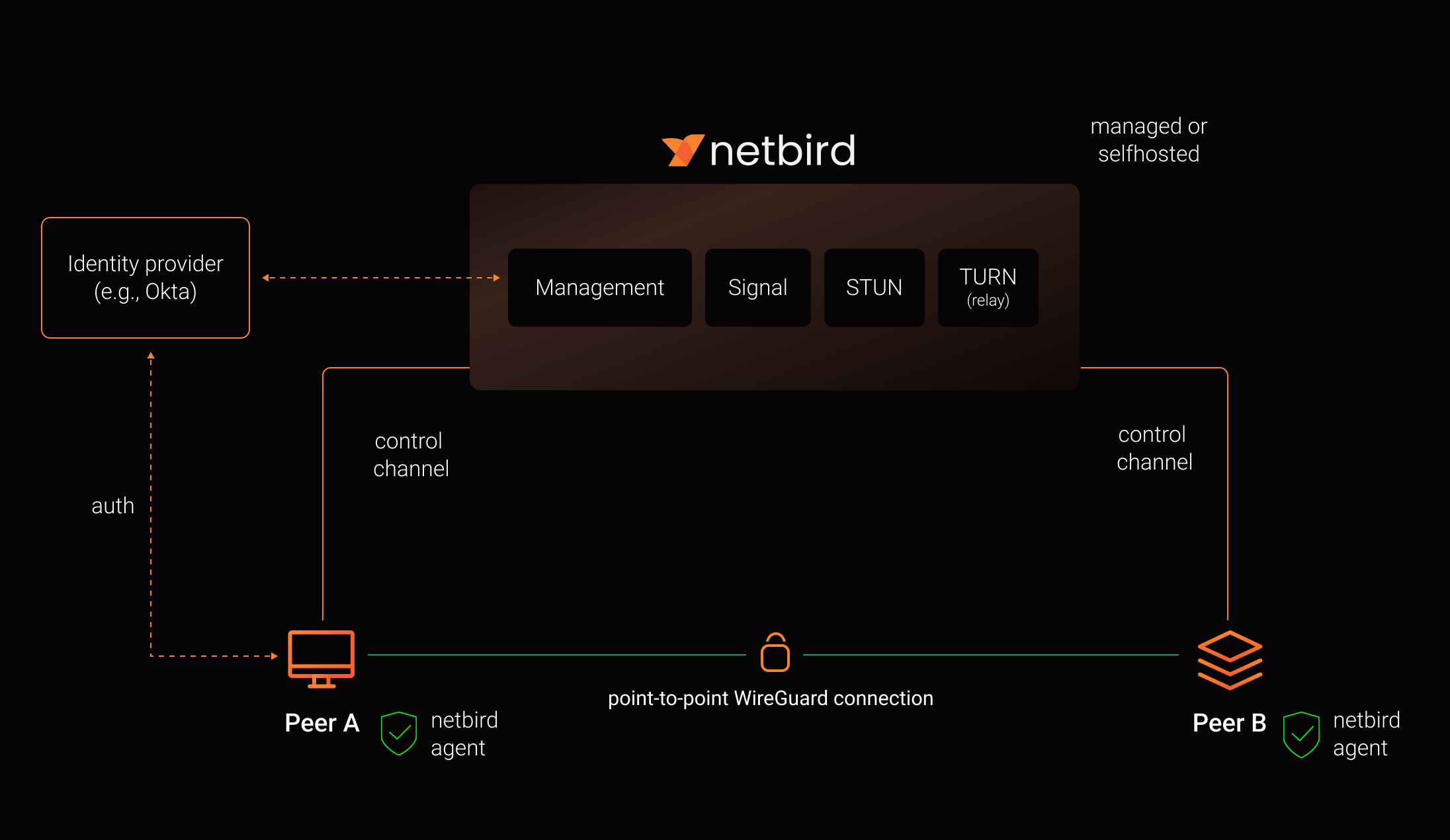
See a complete architecture overview for details.
Community projects
- NetBird installer script
- netbird-tui - terminal UI for managing NetBird peers, routes, and settings
- caddy-netbird - Caddy plugin that embeds a NetBird client for proxying HTTP and TCP/UDP traffic through NetBird networks
Note: The main branch may be in an unstable or even broken state during development.
For stable versions, see releases.
Support acknowledgement
In November 2022, NetBird joined the StartUpSecure program sponsored by the Federal Ministry of Education and Research of the Federal Republic of Germany. Together with the CISPA Helmholtz Center for Information Security, NetBird brings security best practices and simplicity to private networking.

Acknowledgements
We build on open source technologies like WireGuard®, Pion ICE, and Rosenpass. We greatly appreciate the work these projects are doing, and we'd love it if you could support them too (e.g., by starring or contributing).
Legal
This repository is licensed under the BSD-3-Clause license, which applies to all parts of the repository except for the directories management/, signal/ and relay/. Those directories are licensed under the GNU Affero General Public License version 3.0 (AGPLv3). See the respective LICENSE files inside each directory.
WireGuard and the WireGuard logo are registered trademarks of Jason A. Donenfeld.