 Zoltan Papp
ac9529ea8c
Zoltan Papp
ac9529ea8c
* [client] always clean up on Engine.Start failure via defer

The rosenpass init paths (NewManager/Run) returned without calling
e.close(), leaking the WireGuard interface and other partially
initialized state on failure. Per-branch cleanup was easy to miss when
adding new early returns.

Convert Start to a named error return and tear down via a single defer
that calls e.close() whenever err != nil, removing the scattered
per-branch close() calls (including the redundant one in initFirewall).

* [client] make Engine single-use and guard against double Start

Create the run context once in NewEngine instead of in Start. This
keeps e.cancel valid for the engine's whole lifetime, so Stop can
cancel a Start that is blocked waiting on the network while holding
syncMsgMux: Stop now cancels before taking the lock, unblocking that
Start so it can release the mutex.

Reject re-entry into Start: a non-nil wgInterface means a prior Start
already ran (ErrEngineAlreadyStarted), and a cancelled run context
means the engine was stopped (ErrEngineAlreadyStopped). Both checks run
before the cleanup defer so a duplicate call cannot tear down the
running engine's state.

* [client] let engine context unblock WaitStreamConnected

WaitStreamConnected only watched the signal client's own context, which
derives from the parent engineCtx rather than the engine's run context.
A Start blocked here (signal stream not yet up) could therefore not be
released by Engine.Stop, since Stop only cancels the engine's run
context.

Pass a context into WaitStreamConnected and select on it too, and have
the engine pass e.ctx, so Stop cancelling e.ctx unblocks a parked Start.
Update the Client interface, the mock, and callers accordingly.

* [client] fix Start/Stop race by making the run loop own engine shutdown

ConnectClient.Stop stopped the engine directly while the run loop's
backoff cycle could still be starting an engine, so Engine.close raced
Engine.Start (e.g. firewall setup reading wgInterface while close nils
it). embed.Client.Start's rollback only avoided a deadlock by cancelling
before Stop; the race itself remained and was caught by -race.

Make the run loop the sole owner of engine shutdown: derive the run
context in NewConnectClient, and have Stop cancel it and wait for the
loop to exit (skipping the wait when the loop never ran) instead of
calling engine.Stop. The loop now always stops the engine on its way
out, dropping the unsynchronised wgInterface check it used to guard that
call. Self-calls from within the loop use runCancel to avoid waiting on
themselves.

embed keeps a defensive pre-Stop cancel(); the daemon's cleanupConnection
gets a TODO to adopt Stop() rather than stopping the engine in parallel.

* [client] init context state in engine tests

Engine tests built the engine context with context.WithCancel(
context.Background()), omitting CtxInitState. Now that the run context
is created in the constructor, the wgIfaceMonitor goroutine can reach
triggerClientRestart during teardown, which calls CtxGetState and
panics on the missing state. Real entry points (up, embed, service)
always CtxInitState; only the tests skipped it.

* [client] interrupt connect backoff on context cancel

The run loop retried with a raw ExponentialBackOff, so a backoff sleep
ignored context cancellation. Now that ConnectClient.Stop waits for the
run loop to exit, a cancel landing during a sleep would block Stop for
the full interval (up to MaxInterval). Wrap the backoff with the run
context so Retry returns promptly on cancel; the retry budget itself
(MaxElapsedTime) is unchanged.

* [client] bound WaitStreamConnected in signal client tests

The tests waited on WaitStreamConnected with context.Background() and the
client's own context was also Background, so a stream that never connects
would hang until the suite timeout. Pass a 5s timeout context and assert
StreamConnected afterwards so the tests fail fast with a clear reason.

* [client] fix WaitStreamConnected stale-channel race

The StreamConnected check and the wait-channel creation took the mutex
separately, so notifyStreamConnected could set the status and close/clear
connectedCh in between: the waiter then created a fresh channel nobody
would ever close and blocked forever. Also, the status read was unlocked
while notify wrote it under the mutex (a data race). Do the check and the
channel fetch in one locked section; drop the now-unused
getStreamStatusChan helper. Pre-existing bug, not introduced by this branch.

* [client] abort Start if context cancelled while waiting for signal stream

receiveSignalEvents blocks in WaitStreamConnected until the signal stream
connects or the context is cancelled. If Stop cancelled e.ctx while Start
was parked there, Start kept going: it started the remaining subsystems on
a cancelled context and marked a shutting-down engine as started. Return
the context error from receiveSignalEvents and propagate it from Start, so
the deferred cleanup runs and the cancellation reaches the caller.

* [client] clean up all started components on Start failure

Start's failure defer only called close(), which covers the wg interface,
firewall, rosenpass and port forwarding but leaves connMgr, srWatcher,
route/DNS/flow/state managers and the monitor goroutines running. A late
failure (e.g. the context-cancelled check after the signal stream) thus
leaked them.

Extract Stop's locked teardown into stopLocked (caller holds syncMsgMux,
does not wait on shutdownWg) and call it from both Stop and Start's defer.
The defer also cancels the run context first so goroutines started before
the failure unwind. Teardown order is unchanged.





Start using NetBird at netbird.io
See Documentation
Join our Slack channel or our Community forum
🚀 We are hiring! Join us at careers.netbird.io
NetBird combines a configuration-free peer-to-peer private network and a centralized access control system in a single platform, making it easy to create secure private networks for your organization or home.
Connect. NetBird creates a WireGuard-based overlay network that automatically connects your machines over an encrypted tunnel, leaving behind the hassle of opening ports, complex firewall rules, VPN gateways, and so forth.
Secure. NetBird enables secure remote access by applying granular access policies while allowing you to manage them intuitively from a single place. Works universally on any infrastructure.
https://github.com/user-attachments/assets/10cec749-bb56-4ab3-97af-4e38850108d2
Self-host NetBird (video)

Key features
Quickstart with NetBird Cloud
- Download and install NetBird at https://app.netbird.io/install.
- Follow the steps to sign up with Google, Microsoft, GitHub or your email address.
- Check the NetBird admin UI.
Quickstart with self-hosted NetBird
This is the quickest way to try self-hosted NetBird. It should take around 5 minutes to get started if you already have a public domain and a VM. Follow the Advanced guide with a custom identity provider for installations with different IdPs.
Infrastructure requirements:
- A Linux VM with at least 1 CPU and 2 GB of memory.
- The VM should be publicly accessible on TCP ports 80 and 443 and UDP port 3478.
- A public domain name pointing to the VM.
Software requirements:
- Docker with the Compose plugin (Compose v2 or higher). See the Docker installation guide.
Steps
- Download and run the installation script:
export NETBIRD_DOMAIN=netbird.example.com; curl -fsSL https://github.com/netbirdio/netbird/releases/latest/download/getting-started.sh | bash
A bit on NetBird internals
- Every machine in the network runs the NetBird agent, which manages WireGuard.
- Every agent connects to the Management Service, which holds network state, manages peer IPs, and distributes updates to agents.
- Agents use ICE (via pion/ice) to discover connection candidates for peer-to-peer connections.
- Candidates are discovered with the help of STUN servers.
- Agents negotiate a connection through the Signal Service, exchanging end-to-end encrypted messages with candidates.
- When NAT traversal fails (e.g. mobile carrier-grade NAT) and a direct p2p connection isn't possible, the system falls back to a Relay Service and a secure WireGuard tunnel is established through it.
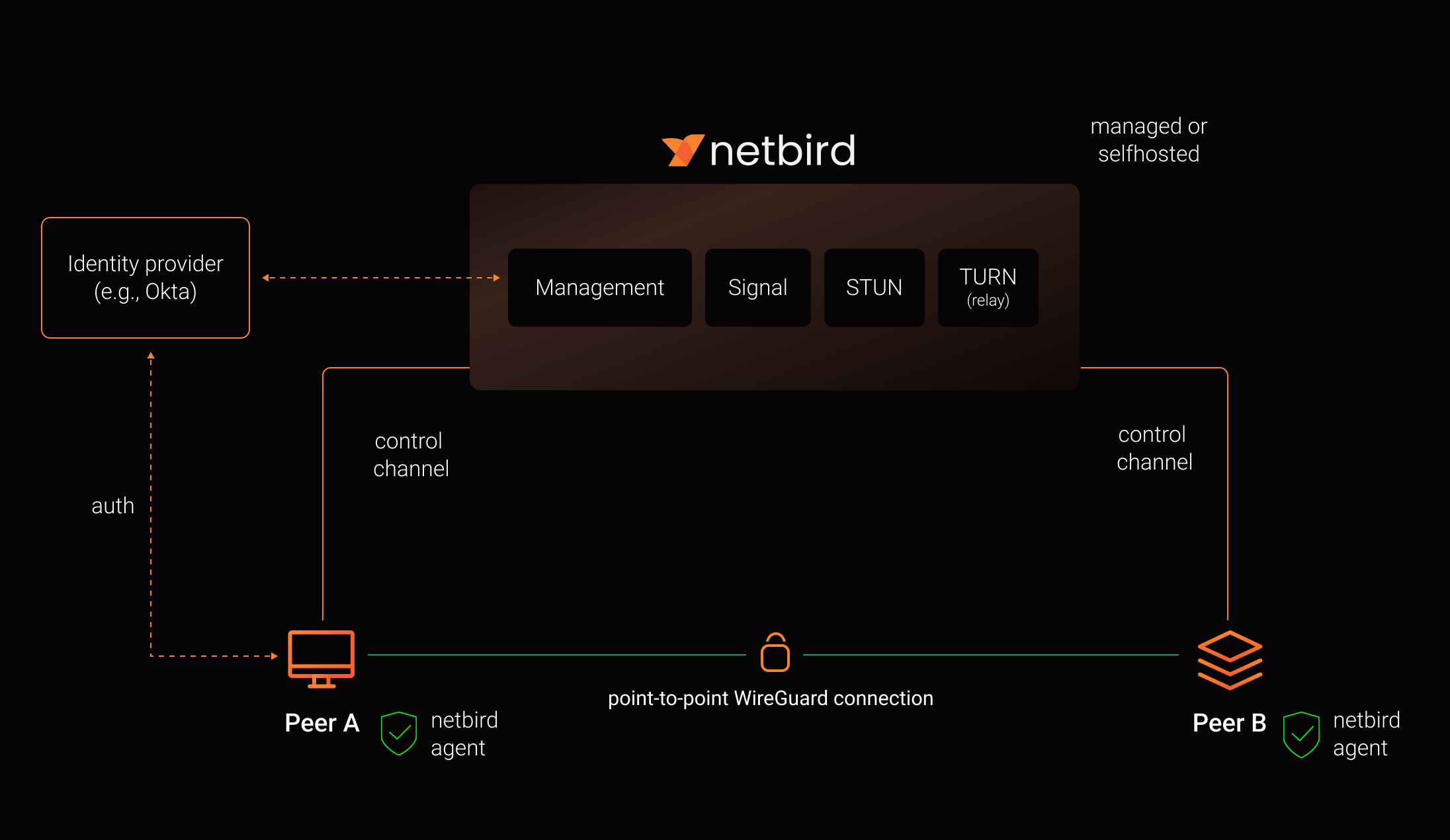
See a complete architecture overview for details.
Community projects
- NetBird installer script
- netbird-tui - terminal UI for managing NetBird peers, routes, and settings
- caddy-netbird - Caddy plugin that embeds a NetBird client for proxying HTTP and TCP/UDP traffic through NetBird networks
Note: The main branch may be in an unstable or even broken state during development.
For stable versions, see releases.
Support acknowledgement
In November 2022, NetBird joined the StartUpSecure program sponsored by the Federal Ministry of Education and Research of the Federal Republic of Germany. Together with the CISPA Helmholtz Center for Information Security, NetBird brings security best practices and simplicity to private networking.

Acknowledgements
We build on open-source technologies like WireGuard®, Pion ICE, and Rosenpass. We greatly appreciate the work these projects are doing, and we'd love it if you could support them too (e.g., by starring or contributing).
Legal
This repository is licensed under the BSD-3-Clause license, which applies to all parts of the repository except for the directories management/, signal/ and relay/. Those directories are licensed under the GNU Affero General Public License version 3.0 (AGPLv3). See the respective LICENSE files inside each directory.
WireGuard and the WireGuard logo are registered trademarks of Jason A. Donenfeld.