 Riccardo Manfrin
a419e770d9
Riccardo Manfrin
a419e770d9
* [client] Track the WireGuard device on the engine as a lock-free handle

Add an atomic handle on the wg device next to wgInterface, stored once the
interface is up and cleared when it is closed. Nothing reads it yet, so this
is a pure addition with no behavior change; it exists so the next commit can
reach the device without taking syncMsgMux.

* [client] Retune the WireGuard buffer pool without the engine lock

SetPerformance took syncMsgMux before reaching the device. That lock is held
by handleSync while it adds and removes peers, and peer removal is exactly
what blocks when a device's buffer pool is exhausted: Peer.Stop waits on a
keepalive timer callback that is itself parked in WaitPool.Get. Raising the
cap is the way out of that state, so the call must not queue behind the lock
the stall is holding.

Read the device through the atomic handle instead. Device.SetPreallocatedBuffersPerPool
takes the pool's own lock and broadcasts, so the waiters wake up.

* [proxy] Extract the buffer-cap apply loop out of the perf handler

Pure move: the loop over the registered clients becomes applyBufferCap, with
the same sequential behavior and the same return values. Split out so the next
commit can change how it iterates without the diff also carrying the move.

* [proxy] Bound the perf endpoint so one wedged client cannot hold it

The apply loop was sequential and unbounded. embed.Client.SetPerformance goes
through the client lock, which Start holds for the whole of a startup, so a
single account that is busy or wedged delayed the new buffer cap for every
other account on the node -- on the endpoint whose whole purpose is to
un-wedge a node.

Apply to all clients concurrently and give the whole call a 5s budget.
Accounts that do not answer in time are reported in "failed" instead of
blocking the response.

* [client] Drop the device handle before closing the interface

close() cleared the atomic handle only after wgInterface.Close() returned, so a
concurrent SetPerformance could still load it, retune a device that is being
torn down, and report the change as applied for an engine that has stopped.
Clear it first, so the window closes before the teardown begins.

Reported by cubic on PR #7452.

* [proxy] Put the per-client retune behind a field

Pure refactor: applyBufferCap calls h.setPerformance instead of the client
method directly, and NewHandler wires it to setClientPerformance. Same call,
same behavior; the seam is what lets the next two commits be tested without a
live embedded client.

* [proxy] Do not report a finished retune as timed out

When the deadline fires, select chooses at random among the ready cases, so a
result already sitting in the buffered channel could be skipped and its account
reported as timed out even though the cap had been applied. Drain what is
buffered before declaring the rest pending.

Reported by cubic on PR #7452.

* [proxy] Keep one retune per account in flight

The 5s budget bounds how long the endpoint waits, not the work: SetPerformance
goes through the embedded client's lock, and on a wedged account Stop holds that
lock forever, so every retry left one more goroutine parked there.

Route each account through a single worker. A request that finds one already
running takes its result if it has landed, and otherwise reports the account
under "in_flight" instead of starting a second attempt. One stuck account now
costs one goroutine, no matter how often the endpoint is called.

Reported by CodeRabbit and cubic on PR #7452.

* [proxy] Make the retune budget a var

Pure refactor: perfApplyTimeout becomes a var so a test can shorten it instead
of waiting five seconds. Same value, same behavior in production.

* [proxy] Extract the buffered-result drain

Pure refactor: the loop that empties the results channel when the deadline
fires becomes collectBuffered. Same behavior; split out so it can be tested
on its own, which the inline version could not be without racing the deadline.

* [proxy] Cover the retune single-flight and the deadline drain

TestApplyBufferCapSingleFlightPerAccount fails without the worker registry:
five calls against a client stuck in its own lock start five blocked workers
instead of one.

TestCollectBufferedCountsResultsReadyAtTheDeadline pins the drain helper's
contract - buffered results counted, errors recorded, only unanswered accounts
left pending. It drives collectBuffered directly: through applyBufferCap the
two select cases race by construction, so an end-to-end version of it would
pass on the unfixed code about half the time.

* [proxy] Keep the worker alongside each pending account

Pure refactor: the pending set becomes a map to the account's worker instead of
an empty struct. Same membership and same behavior; the next commit needs the
worker to resolve an account whose result has not reached the channel yet.

* [proxy] Publish a retune result before releasing its slot

The worker sent its result last, after taking perfMu to remove itself from the
registry. That lock is taken once per account by every caller walking the fleet,
so a worker that finished on time could queue behind an apply over thousands of
accounts and land after the deadline. Send first, deregister after.

Reported by cubic on PR #7452.

* [proxy] Read the worker, not the clock, for a finished retune

Publishing earlier only narrows the window: a client that answers just before
the deadline can still be reported as timed out. At the deadline the workers
themselves are authoritative - a closed done channel means the retune finished
and w.err carries its outcome, ordered by the close. Consult them instead of
declaring every pending account timed out, and keep the timeout label for the
ones actually still running.

Reported by cubic on PR #7452.

* [proxy] Cover the finished-worker resolution at the deadline

Fails on the previous behavior with "applied = 0, want 1": every pending
account was labelled a timeout, including the one whose retune had already
completed.





Start using NetBird at netbird.io
See Documentation
Join our Slack channel or our Community forum
🚀 We are hiring! Join us at https://netbird.io/careers
🤖 NetBird Agent Network (Beta)
Identity-aware access control for AI agents — keyless access to LLM APIs and private resources over the encrypted NetBird tunnel. See
agent-network/or read the docs at netbird.ai.
NetBird combines a configuration-free peer-to-peer private network and a centralized access control system in a single platform, making it easy to create secure private networks for your organization or home.
Connect. NetBird creates a WireGuard-based overlay network that automatically connects your machines over an encrypted tunnel, leaving behind the hassle of opening ports, complex firewall rules, VPN gateways, and so forth.
Secure. NetBird enables secure remote access by applying granular access policies while allowing you to manage them intuitively from a single place. Works universally on any infrastructure.
https://github.com/user-attachments/assets/10cec749-bb56-4ab3-97af-4e38850108d2
Self-host NetBird (video)

Key features
Quickstart with NetBird Cloud
- Download and install NetBird at https://app.netbird.io/install.
- Follow the steps to sign up with Google, Microsoft, GitHub or your email address.
- Check the NetBird admin UI.
Quickstart with self-hosted NetBird
This is the quickest way to try self-hosted NetBird. It should take around 5 minutes to get started if you already have a public domain and a VM. Follow the Advanced guide with a custom identity provider for installations with different IdPs.
Infrastructure requirements:
- A Linux VM with at least 1 CPU and 2 GB of memory.
- The VM should be publicly accessible on TCP ports 80 and 443 and UDP port 3478.
- A public domain name pointing to the VM.
Software requirements:
- Docker with the Compose plugin (Compose v2 or higher). See the Docker installation guide.
Steps
- Download and run the installation script:
export NETBIRD_DOMAIN=netbird.example.com; curl -fsSL https://github.com/netbirdio/netbird/releases/latest/download/getting-started.sh | bash
A bit on NetBird internals
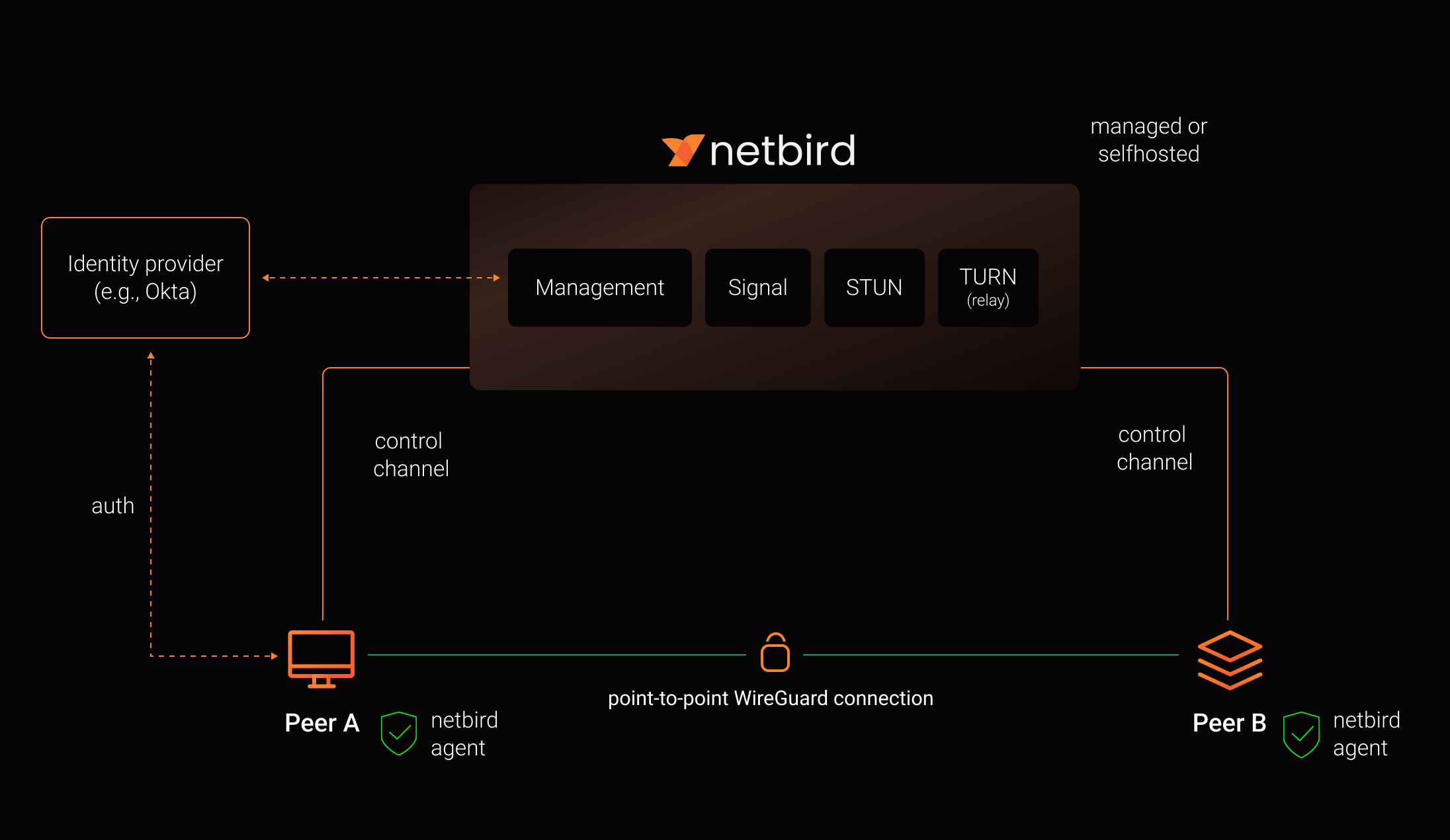
- Every machine in the network runs the NetBird agent, which manages WireGuard.
- Every agent connects to the Management Service, which holds network state, manages peer IPs, and distributes updates to agents.
- Agents use ICE (via pion/ice) to discover connection candidates for peer-to-peer connections.
- Candidates are discovered with the help of STUN servers.
- Agents negotiate a connection through the Signal Service, exchanging end-to-end encrypted messages with candidates.
- When NAT traversal fails (e.g. mobile carrier-grade NAT) and a direct p2p connection isn't possible, the system falls back to a Relay Service and a secure WireGuard tunnel is established through it.
See a complete architecture overview for details.
Community projects
- NetBird installer script
- netbird-tui - terminal UI for managing NetBird peers, routes, and settings
- caddy-netbird - Caddy plugin that embeds a NetBird client for proxying HTTP and TCP/UDP traffic through NetBird networks
Note: The main branch may be in an unstable or even broken state during development.
For stable versions, see releases.
Support acknowledgement
In November 2022, NetBird joined the StartUpSecure program sponsored by the Federal Ministry of Education and Research of the Federal Republic of Germany. Together with the CISPA Helmholtz Center for Information Security, NetBird brings security best practices and simplicity to private networking.

Acknowledgements
We build on open source technologies like WireGuard®, Pion ICE, and Rosenpass. We greatly appreciate the work these projects are doing, and we'd love it if you could support them too (e.g., by starring or contributing).
Legal
This repository is licensed under the BSD-3-Clause license, which applies to all parts of the repository except for the directories management/, signal/ and relay/. Those directories are licensed under the GNU Affero General Public License version 3.0 (AGPLv3). See the respective LICENSE files inside each directory.
WireGuard and the WireGuard logo are registered trademarks of Jason A. Donenfeld.