 Riccardo Manfrin
6620219939
Riccardo Manfrin
6620219939
* [client] Add catch-all NRPT rule when NetBird is the primary DNS resolver

* Remove obvious comments

* Install the catch-all rule where the adapter's DNS is set

addDNSSetupForAll makes us the peer's main DNS forwarder, and the catch-all NRPT
rule is the other half of that same job: without it the adapter's NameServer only
adds one more resolver to the set Windows queries in parallel. Having the two in
one place says that, where a separate block at the end of applyDNSConfig read as
an afterthought.

The block could not simply move up: removeDNSMatchPolicies deletes the catch-all
key too, so installing the rule before it ran would have had the rule deleted
moments later. The cleanup now runs first, which is what it was always for - it
clears what the previous apply installed before this one installs anything - and
keeps being unconditional, so a leftover rule from an earlier run cannot survive
into a config that no longer wants it.

* Name the escape hatch after the behaviour it restores

NB_DISABLE_DNS_CATCHALL_NRPT described the mechanism it switches off. What an
operator reaching for it wants is the behaviour they had before, so name it that:
NB_USE_LEGACY_DNS_RESOLUTION, matching NB_USE_LEGACY_ROUTING, the only other
legacy switch in the client.

Not NB_WIN_LEGACY_FULL_TUNNEL_DNS_RESOLVE, as first suggested: the rule follows a
primary nameserver group, not a full tunnel, and putting FULL_TUNNEL in a public
variable name would carry that confusion for as long as the variable lives. No
OS prefix either, since nothing else in the client has one and this switch is
inert anywhere but Windows by construction.

Behaviour and default are unchanged: the catch-all rule is on unless the variable
says otherwise.

* Exempt .local from the catch-all rule

RFC 6762 reserves .local for multicast DNS and says unicast resolvers must not
answer for it. The catch-all rule hands it to us anyway, we forward it to
whatever upstream the primary nameserver group points at, and the answer comes
back NXDOMAIN for hosts that do exist - printers, NAS boxes, anything
announcing itself on the link. Confirmed on a Win11Pro VM: laptop.local resolves
with the client down and returns "Nome DNS inesistente" with it up, and the
client log shows the query arriving on the catch-all handler and being forwarded
to 1.1.1.1.

An NRPT rule that names a namespace and lists no servers is an exemption: the
DNS client resolves those names as it would with no rule at all. What that looks
like in the registry is not what it sounds like. Writing no server value and
clearing ConfigOptions produces a rule Windows treats as a no-op - it never
appears in Get-DnsClientNrptPolicy -Effective and the catch-all keeps the query.
The value has to be present and empty, with ConfigOptions still 0x8: the flag
says the server list is the meaningful part of the rule, and an empty list then
means "no server, resolve normally". Verified both encodings on the VM.

Installed together with the catch-all, since without one nothing captures .local
in the first place, and removed with it.

Exclusivity is unaffected elsewhere, and a more specific rule still wins - a
match domain under .local keeps resolving through NetBird, which is what a
legacy Active Directory domain named corp.local needs. Verified separately that
a match domain does take precedence over the catch-all: declaring fritz.box
against the local router restored laptop.fritz.box while the catch-all was in
force.

* Treat the root namespace as a match domain, not a special case

The catch-all had a function, a registry key and a call site of its own, which
made it look like a different mechanism. It is not: "." is an NRPT namespace like
any other, it just happens to match every name. So it goes into the match domain
list, and addDNSMatchPolicy writes it along with the rest — batching, GPO
variant, volatile keys and cleanup all come for free.

The .local exemption stays a rule of its own, and not for symmetry: it is the one
rule with a different server list, an empty one. Putting it in the same Name
value would give it our resolver and exempt nothing.

Windows expands a rule's Name value into one effective namespace each, so a rule
carrying {.example.com, .} still shows both as separate rows in
Get-DnsClientNrptPolicy -Effective. Nothing is lost for diagnosis by dropping the
dedicated key.

Suggested by Vik in review.

* Do not report a failed NRPT cleanup as success

removeRegistryKeyFromDNSPolicyConfig returned nil for every OpenKey error, so a
permission or registry failure was indistinguishable from a key that was never
there. Cleanup then reported success while the rule stayed in force — which is
how a rule outlives the interface it points at and keeps sending every query to
an address that no longer answers.

Distinguish the two, the way listNRPTRuleKeys already does for the policy store
root: a missing key is nothing to do, anything else reaches the caller.

restoreHostDNS now propagates that error instead of logging it. applyDNSConfig
keeps logging on purpose: there we are about to write fresh rules over whatever
survived, while restore is the path where a rule left behind is the whole
problem.

Also addresses review nits on the tests: doc comments on the two added cases,
reported Close and DeleteKey errors so a failed cleanup cannot contaminate the
next registry test, and a context message on the exemption's namespace assertion.





Start using NetBird at netbird.io
See Documentation
Join our Slack channel or our Community forum
🚀 We are hiring! Join us at https://netbird.io/careers
🤖 NetBird Agent Network (Beta)
Identity-aware access control for AI agents — keyless access to LLM APIs and private resources over the encrypted NetBird tunnel. See
agent-network/or read the docs at netbird.ai.
NetBird combines a configuration-free peer-to-peer private network and a centralized access control system in a single platform, making it easy to create secure private networks for your organization or home.
Connect. NetBird creates a WireGuard-based overlay network that automatically connects your machines over an encrypted tunnel, leaving behind the hassle of opening ports, complex firewall rules, VPN gateways, and so forth.
Secure. NetBird enables secure remote access by applying granular access policies while allowing you to manage them intuitively from a single place. Works universally on any infrastructure.
https://github.com/user-attachments/assets/10cec749-bb56-4ab3-97af-4e38850108d2
Self-host NetBird (video)

Key features
Quickstart with NetBird Cloud
- Download and install NetBird at https://app.netbird.io/install.
- Follow the steps to sign up with Google, Microsoft, GitHub or your email address.
- Check the NetBird admin UI.
Quickstart with self-hosted NetBird
This is the quickest way to try self-hosted NetBird. It should take around 5 minutes to get started if you already have a public domain and a VM. Follow the Advanced guide with a custom identity provider for installations with different IdPs.
Infrastructure requirements:
- A Linux VM with at least 1 CPU and 2 GB of memory.
- The VM should be publicly accessible on TCP ports 80 and 443 and UDP port 3478.
- A public domain name pointing to the VM.
Software requirements:
- Docker with the Compose plugin (Compose v2 or higher). See the Docker installation guide.
Steps
- Download and run the installation script:
export NETBIRD_DOMAIN=netbird.example.com; curl -fsSL https://github.com/netbirdio/netbird/releases/latest/download/getting-started.sh | bash
A bit on NetBird internals
- Every machine in the network runs the NetBird agent, which manages WireGuard.
- Every agent connects to the Management Service, which holds network state, manages peer IPs, and distributes updates to agents.
- Agents use ICE (via pion/ice) to discover connection candidates for peer-to-peer connections.
- Candidates are discovered with the help of STUN servers.
- Agents negotiate a connection through the Signal Service, exchanging end-to-end encrypted messages with candidates.
- When NAT traversal fails (e.g. mobile carrier-grade NAT) and a direct p2p connection isn't possible, the system falls back to a Relay Service and a secure WireGuard tunnel is established through it.
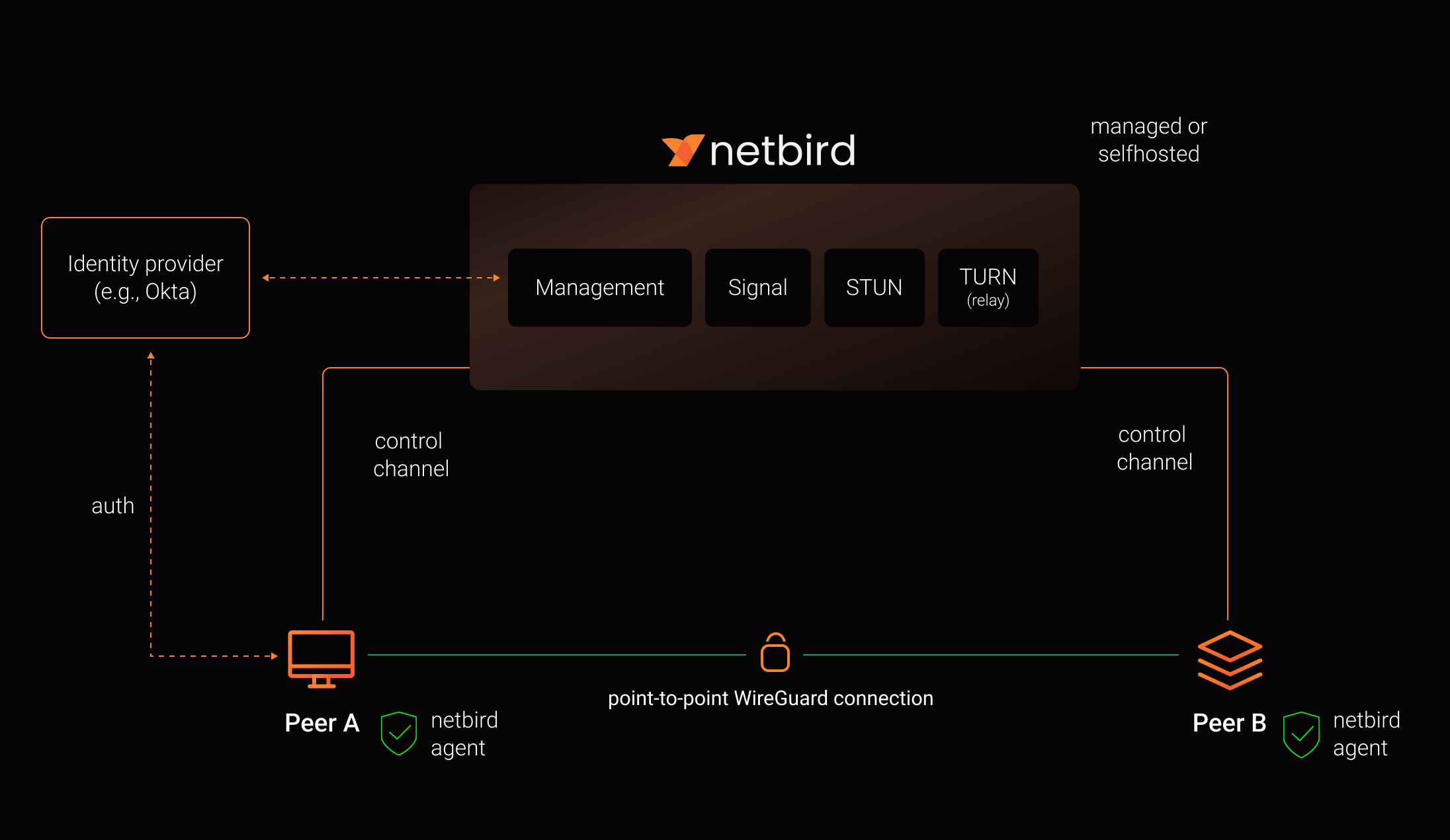
See a complete architecture overview for details.
Community projects
- NetBird installer script
- netbird-tui - terminal UI for managing NetBird peers, routes, and settings
- caddy-netbird - Caddy plugin that embeds a NetBird client for proxying HTTP and TCP/UDP traffic through NetBird networks
Note: The main branch may be in an unstable or even broken state during development.
For stable versions, see releases.
Support acknowledgement
In November 2022, NetBird joined the StartUpSecure program sponsored by the Federal Ministry of Education and Research of the Federal Republic of Germany. Together with the CISPA Helmholtz Center for Information Security, NetBird brings security best practices and simplicity to private networking.

Acknowledgements
We build on open source technologies like WireGuard®, Pion ICE, and Rosenpass. We greatly appreciate the work these projects are doing, and we'd love it if you could support them too (e.g., by starring or contributing).
Legal
This repository is licensed under the BSD-3-Clause license, which applies to all parts of the repository except for the directories management/, signal/ and relay/. Those directories are licensed under the GNU Affero General Public License version 3.0 (AGPLv3). See the respective LICENSE files inside each directory.
WireGuard and the WireGuard logo are registered trademarks of Jason A. Donenfeld.