 61137a54c2
* [e2e] Add container-based agent-network e2e harness (Pillar 1)

Introduce a self-contained, OIDC-free e2e harness that stands up NetBird
in containers, so suites no longer depend on the hand-maintained Tilt
stack or a real IdP.

- harness brings up the combined server (management + signal + relay +
  STUN + embedded IdP) in a single container built from
  combined/Dockerfile.multistage, and mints an admin PAT through the
  unauthenticated /api/setup bootstrap (NB_SETUP_PAT_ENABLED). API access
  goes through the existing shared/management/client/rest typed client.
- the image is built via the docker CLI (BuildKit) so the Dockerfile's
  cache mounts are honored; testcontainers then runs the tagged image.
- everything is behind the `e2e` build tag so normal builds and unit
  tests never pull in testcontainers.

Adds BuildKit cache mounts to combined/Dockerfile.multistage so source
changes recompile incrementally rather than from scratch.

Pillar 1 proven by TestCombinedBootstrap: server builds, boots, mints a
PAT, and the PAT authenticates a real management API call.

* [e2e] Add management-side agent-network scenarios (Pillar 2)

Port the API-driven agent-network scenarios from the bash suites to Go,
sharing one combined server per package run (TestMain) with each test
owning its resource cleanup. Drives the /api/agent-network/* endpoints
through the shared REST client's NewRequest primitive with the generated
api types.

Scenarios:
- provider lifecycle (create/get/list/delete + 404 after delete)
- provider validation (missing api_key, unknown catalog id → 4xx)
- settings collection-toggle round-trip with cluster/subdomain immutability
- policy window floor (reject <60s enabled limit, accept at 60s)
- consumption read endpoint returns an array

All deterministic and dependency-free (dummy provider keys; no upstream
calls), so they run headless in CI.

* [e2e] Add live chat-through-proxy scenario (Pillar 3)

Stand up the full agent-network data path in containers and drive a real
chat-completion through the gateway:

- harness: a shared docker network (combined server reachable by alias),
  a proxy container built from the published reverse-proxy image
  (NB_PROXY_PRIVATE, NB_PROXY_ALLOW_INSECURE, NB_RELAY_TRANSPORT=ws to match
  the combined server's WS-multiplexed relay) with a generated self-signed
  wildcard cert, and a netbird client container that joins via a setup key.
- the combined image, proxy image, and client image default to the
  published rc.2 releases (overridable via NB_E2E_*_IMAGE; a bare local tag
  is built from source instead). Geolocation download is disabled so the
  server starts without external fetches.
- one shared domain is used for the management exposed address, the proxy
  domain, and the agent-network cluster; the proxy token is minted via the
  server CLI (global) to match the manual install.

TestChatCompletionThroughProxy provisions provider+policy+group+setup key,
runs proxy+client, drives an OpenAI chat-completion through the tunnel, and
asserts a 200 plus the ingested access-log row. Requires OPENAI_TOKEN
(skips otherwise). The provider must be created with enabled=true explicitly
— the create default is false despite the API doc.

* [e2e] Run the live chat scenario across a provider matrix

Replace the single-provider chat test with a data-driven matrix that runs
the same scenario through every provider whose credentials are present in
the environment (keys/URLs sourced from ~/.llm-keys locally, Actions
secrets in CI):

- OpenAI (chat), Anthropic (messages), Vercel, OpenRouter, Cloudflare
  (OpenAI-compatible gateways), and Bedrock (path-routed, bearer, via the
  messages shape) — covering both wire shapes and the gateway routing.
- all providers are created enabled with a unique model string so the
  proxy's connect-time snapshot carries them all and model->provider
  routing is unambiguous (provider toggles after connect don't reconcile
  to a connected proxy).
- the client supports both wire shapes (/v1/chat/completions and
  /v1/messages); Cloudflare gets the openai provider segment appended to
  its gateway URL.

Each provider must return 200 through the tunnel and produce an ingested
access-log row. Vertex is intentionally excluded from the uniform matrix:
it needs a bespoke rawPredict request shape rather than the shared
chat/messages path, so it warrants a dedicated scenario.

* [ci] Add manual workflow for the agent-network e2e suite

The e2e suite (build tag `e2e`) stands up the combined server + proxy +
client in Docker and drives live chat-completions, so it is slow and needs
provider credentials. Gate it out of normal CI (it already is, via the
build tag) and run it on demand via workflow_dispatch. Provider scenarios
skip when their secret is unset, so it degrades gracefully.

* [e2e] Add Vertex to the provider matrix; run e2e on ubuntu-latest

Vertex (Anthropic-on-Vertex) doesn't share the chat/messages wire shapes:
the model travels in a rawPredict path and the proxy mints the service
account's OAuth token. Add a Vertex client method that posts
/v1/projects/<project>/locations/<region>/publishers/anthropic/models/<model>:rawPredict
with the Vertex anthropic_version body, and wire it into the matrix as a
path-routed provider (created without a models array). It is keyed off
GOOGLE_VERTEX_SA_BASE64 + GOOGLE_VERTEX_PROJECT (region defaults to
"global", model to a pinned claude snapshot, both overridable).

Also bump the e2e workflow runner to ubuntu-latest and add the Vertex
secrets.

* Add docker/docker and docker/go-connections as direct dependencies in go.mod

* [ci] Trigger agent-network e2e workflow on push to main and pull requests

* [e2e] Fix proxy cert permission denied on Linux CI runners

The proxy bind-mounts a temp dir of self-signed certs. MkdirTemp creates
it 0700 and the key was 0600, which Docker Desktop on macOS ignores but a
non-root proxy container on Linux runners cannot traverse/read, so the
cert watcher failed with "open /certs/tls.crt: permission denied" and the
container exited. Widen the cert dir to 0755 and write the throwaway key
0644 so the proxy uid can read the bind-mounted material.

* [e2e] Build images from source by default instead of pulling rc.2

The agent-network code under test lives in this branch, so the e2e should
exercise it rather than a frozen published release. Flip the harness
default: combined/proxy/client are now built from their in-repo
Dockerfiles (combined/Dockerfile.multistage, proxy/Dockerfile.multistage,
e2e/harness/Dockerfile.client) under local tags. Pulling a published image
stays available by setting NB_E2E_*_IMAGE to a registry reference.

Builds now go through buildx --load so the Dockerfile cache mounts are
honored and the result is loaded for testcontainers. The CI workflow adds
a container-driver builder and a local layer cache (NB_E2E_BUILDX_CACHE)
persisted via actions/cache, which caches the base/apt/dep-download layers
across runs. The Go compile still re-runs each time, as BuildKit mount
caches cannot be exported to the GitHub cache.

* [e2e] Cover real providers in lifecycle + assert real consumption metering

- TestProviderLifecycle now runs per available real provider (create → get →
  list → delete → 404) instead of a single dummy provider, exercising each
  catalog's create and field round-trip. Create is offline, so it stays fast
  and burns no provider quota; falls back to a synthetic OpenAI provider when
  no keys are set.
- TestProvidersMatrix attaches a token limit (high caps, 60s window) to its
  policy, which switches on usage metering, and asserts consumption rows are
  recorded with positive token counts after the live traffic. Consumption is
  account-scoped (keyed by source group / user and window, not per provider),
  so the assertion is aggregate.
- TestProviderValidation gains invalid-upstream and blank-name cases. Create
  validation is uniform across catalogs (no per-provider required-field rules),
  so per-provider rejection cases would be redundant.

* [e2e] Assert session id propagates per provider

Each matrix request now sends a unique session id as the universal
x-session-id header and asserts it round-trips into that provider's
access-log row. This guards the session-grouping contract end to end for
every provider (header extraction runs in llm_request_parser ahead of the
parser-specific body extraction, so it is provider-agnostic).

* [e2e] Drop accidentally committed sync-phases dashboard

netbird-sync-phases.json was swept into the Pillar 1 commit by a broad
git add; it belongs to the unrelated sync-phases metrics work, not this
e2e harness. Remove it from the branch so the PR diff is scoped to the
e2e changes.

* [e2e] Revert accidentally committed sync-phase ingest spec

The netbird_sync_phase measurement spec in metrics ingest was swept into
the Pillar 1 commit; it belongs to the unrelated sync-phases metrics work,
not this e2e harness. Its emission side never landed here, so the spec was
orphaned anyway. Restore ingest/main.go to its origin/main state.





Start using NetBird at netbird.io
See Documentation
Join our Slack channel or our Community forum
🚀 We are hiring! Join us at https://netbird.io/careers
🤖 NetBird Agent Network (Beta)
Identity-aware access control for AI agents — keyless access to LLM APIs and private resources over the encrypted NetBird tunnel. See
agent-network/or read the docs at netbird.ai.
NetBird combines a configuration-free peer-to-peer private network and a centralized access control system in a single platform, making it easy to create secure private networks for your organization or home.
Connect. NetBird creates a WireGuard-based overlay network that automatically connects your machines over an encrypted tunnel, leaving behind the hassle of opening ports, complex firewall rules, VPN gateways, and so forth.
Secure. NetBird enables secure remote access by applying granular access policies while allowing you to manage them intuitively from a single place. Works universally on any infrastructure.
https://github.com/user-attachments/assets/10cec749-bb56-4ab3-97af-4e38850108d2
Self-host NetBird (video)
Key features
Quickstart with NetBird Cloud
- Download and install NetBird at https://app.netbird.io/install.
- Follow the steps to sign up with Google, Microsoft, GitHub or your email address.
- Check the NetBird admin UI.
Quickstart with self-hosted NetBird
This is the quickest way to try self-hosted NetBird. It should take around 5 minutes to get started if you already have a public domain and a VM. Follow the Advanced guide with a custom identity provider for installations with different IdPs.
Infrastructure requirements:
- A Linux VM with at least 1 CPU and 2 GB of memory.
- The VM should be publicly accessible on TCP ports 80 and 443 and UDP port 3478.
- A public domain name pointing to the VM.
Software requirements:
- Docker with the Compose plugin (Compose v2 or higher). See the Docker installation guide.
Steps
- Download and run the installation script:
export NETBIRD_DOMAIN=netbird.example.com; curl -fsSL https://github.com/netbirdio/netbird/releases/latest/download/getting-started.sh | bash
A bit on NetBird internals
- Every machine in the network runs the NetBird agent, which manages WireGuard.
- Every agent connects to the Management Service, which holds network state, manages peer IPs, and distributes updates to agents.
- Agents use ICE (via pion/ice) to discover connection candidates for peer-to-peer connections.
- Candidates are discovered with the help of STUN servers.
- Agents negotiate a connection through the Signal Service, exchanging end-to-end encrypted messages with candidates.
- When NAT traversal fails (e.g. mobile carrier-grade NAT) and a direct p2p connection isn't possible, the system falls back to a Relay Service and a secure WireGuard tunnel is established through it.
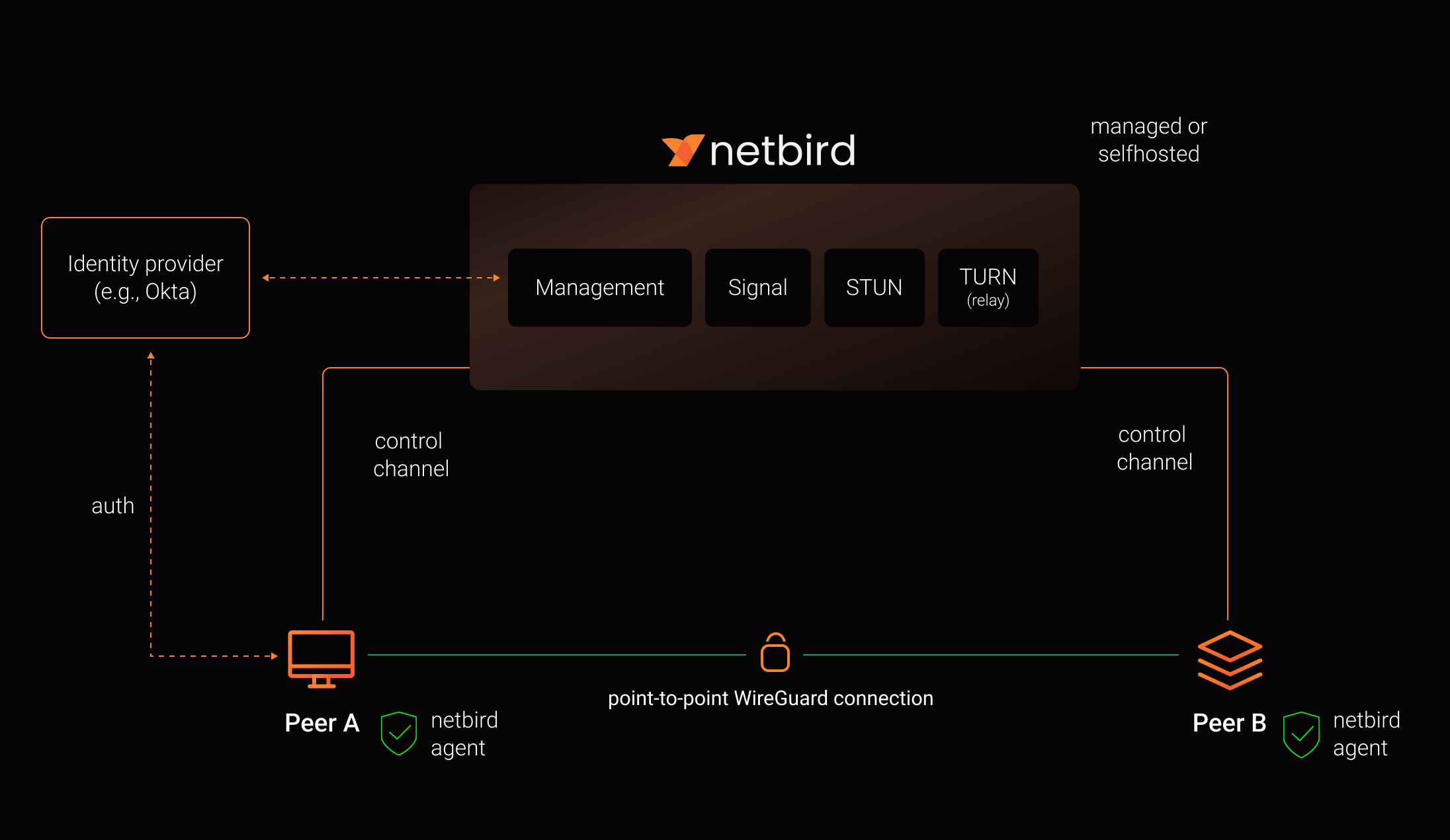
See a complete architecture overview for details.
Community projects
- NetBird installer script
- netbird-tui - terminal UI for managing NetBird peers, routes, and settings
- caddy-netbird - Caddy plugin that embeds a NetBird client for proxying HTTP and TCP/UDP traffic through NetBird networks
Note: The main branch may be in an unstable or even broken state during development.
For stable versions, see releases.
Support acknowledgement
In November 2022, NetBird joined the StartUpSecure program sponsored by the Federal Ministry of Education and Research of the Federal Republic of Germany. Together with the CISPA Helmholtz Center for Information Security, NetBird brings security best practices and simplicity to private networking.

Acknowledgements
We build on open-source technologies like WireGuard®, Pion ICE, and Rosenpass. We greatly appreciate the work these projects are doing, and we'd love it if you could support them too (e.g., by starring or contributing).
Legal
This repository is licensed under the BSD-3-Clause license, which applies to all parts of the repository except for the directories management/, signal/ and relay/. Those directories are licensed under the GNU Affero General Public License version 3.0 (AGPLv3). See the respective LICENSE files inside each directory.
WireGuard and the WireGuard logo are registered trademarks of Jason A. Donenfeld.