 Riccardo Manfrin
3e85e40be2
Riccardo Manfrin
3e85e40be2
* [client] Take a WireGuard detector through the interface filter

The interface filter answers whether an interface is a WireGuard device by opening
a wgctrl client and asking for it, and it does that for every interface it is given.
Nothing about that call is tied to the caller, so it can be answered by a shared
object instead of being repeated, but the filter has no way to receive one.

InterfaceFilter and the constructors that build one now take a detector, and the ICE
config carries it so that every agent can be handed the same one. Nobody supplies a
detector yet: a nil one probes on every call, which is what the filter did before, so
this changes no behaviour.

* [client] Share one WireGuard detector across every ICE agent

Creating an ICE agent builds two interface filters, one for the agent and one for
the transport net it sits on, and each is asked about every host interface. For an
interface the disallow list does not settle, answering means opening a wgctrl client,
which builds a kernel and a userspace client and resolves the netlink family, and
then a round trip that usually just reports the device does not exist. An agent is
created per peer connection attempt, so on a large network that runs constantly:
on a routing peer with ~16000 peers it measured 2.40s of a 66.59s CPU profile, 3.6%,
split evenly between opening the client and the round trip.

The engine now owns a detector and passes it to every agent through the ICE config,
so the answer for an interface is reused instead of being asked again for each agent.
It is kept for a second, short enough that a WireGuard interface appearing is picked
up before ICE settles on candidates over it.

The callers that build one filter and keep it, the relay and the UDP mux, keep
passing nil and so keep probing, which costs them nothing at their rate.

* [client] Recheck the WireGuard cache inside the singleflight group

A caller that saw an expired entry could enter the singleflight group
after another caller had already refreshed the entry and left it, and
probe the interface a second time. Read the cache again inside the group
before probing.

This also makes the concurrent probe test independent of scheduling: a
late caller finds the fresh entry instead of starting a new probe.

* [client] Drop expired WireGuard detector entries

The detector lives as long as the engine and kept an entry for every
interface name it was ever asked about. On hosts that churn interfaces,
such as container veths, the map only grew. Remove expired entries when
a new answer is stored; the map holds a few dozen names at most, so the
sweep is cheap and runs at most once per interface per TTL.

* [client] Skip the disallow-list filter test on iOS

InterfaceFilter does not apply the disallow list on iOS, so the subtest
reaches the probe there and its no-probe assertion cannot hold.





Start using NetBird at netbird.io
See Documentation
Join our Slack channel or our Community forum
🚀 We are hiring! Join us at https://netbird.io/careers
🤖 NetBird Agent Network (Beta)
Identity-aware access control for AI agents — keyless access to LLM APIs and private resources over the encrypted NetBird tunnel. See
agent-network/or read the docs at netbird.ai.
NetBird combines a configuration-free peer-to-peer private network and a centralized access control system in a single platform, making it easy to create secure private networks for your organization or home.
Connect. NetBird creates a WireGuard-based overlay network that automatically connects your machines over an encrypted tunnel, leaving behind the hassle of opening ports, complex firewall rules, VPN gateways, and so forth.
Secure. NetBird enables secure remote access by applying granular access policies while allowing you to manage them intuitively from a single place. Works universally on any infrastructure.
https://github.com/user-attachments/assets/10cec749-bb56-4ab3-97af-4e38850108d2
Self-host NetBird (video)

Key features
Quickstart with NetBird Cloud
- Download and install NetBird at https://app.netbird.io/install.
- Follow the steps to sign up with Google, Microsoft, GitHub or your email address.
- Check the NetBird admin UI.
Quickstart with self-hosted NetBird
This is the quickest way to try self-hosted NetBird. It should take around 5 minutes to get started if you already have a public domain and a VM. Follow the Advanced guide with a custom identity provider for installations with different IdPs.
Infrastructure requirements:
- A Linux VM with at least 1 CPU and 2 GB of memory.
- The VM should be publicly accessible on TCP ports 80 and 443 and UDP port 3478.
- A public domain name pointing to the VM.
Software requirements:
- Docker with the Compose plugin (Compose v2 or higher). See the Docker installation guide.
Steps
- Download and run the installation script:
export NETBIRD_DOMAIN=netbird.example.com; curl -fsSL https://github.com/netbirdio/netbird/releases/latest/download/getting-started.sh | bash
A bit on NetBird internals
- Every machine in the network runs the NetBird agent, which manages WireGuard.
- Every agent connects to the Management Service, which holds network state, manages peer IPs, and distributes updates to agents.
- Agents use ICE (via pion/ice) to discover connection candidates for peer-to-peer connections.
- Candidates are discovered with the help of STUN servers.
- Agents negotiate a connection through the Signal Service, exchanging end-to-end encrypted messages with candidates.
- When NAT traversal fails (e.g. mobile carrier-grade NAT) and a direct p2p connection isn't possible, the system falls back to a Relay Service and a secure WireGuard tunnel is established through it.
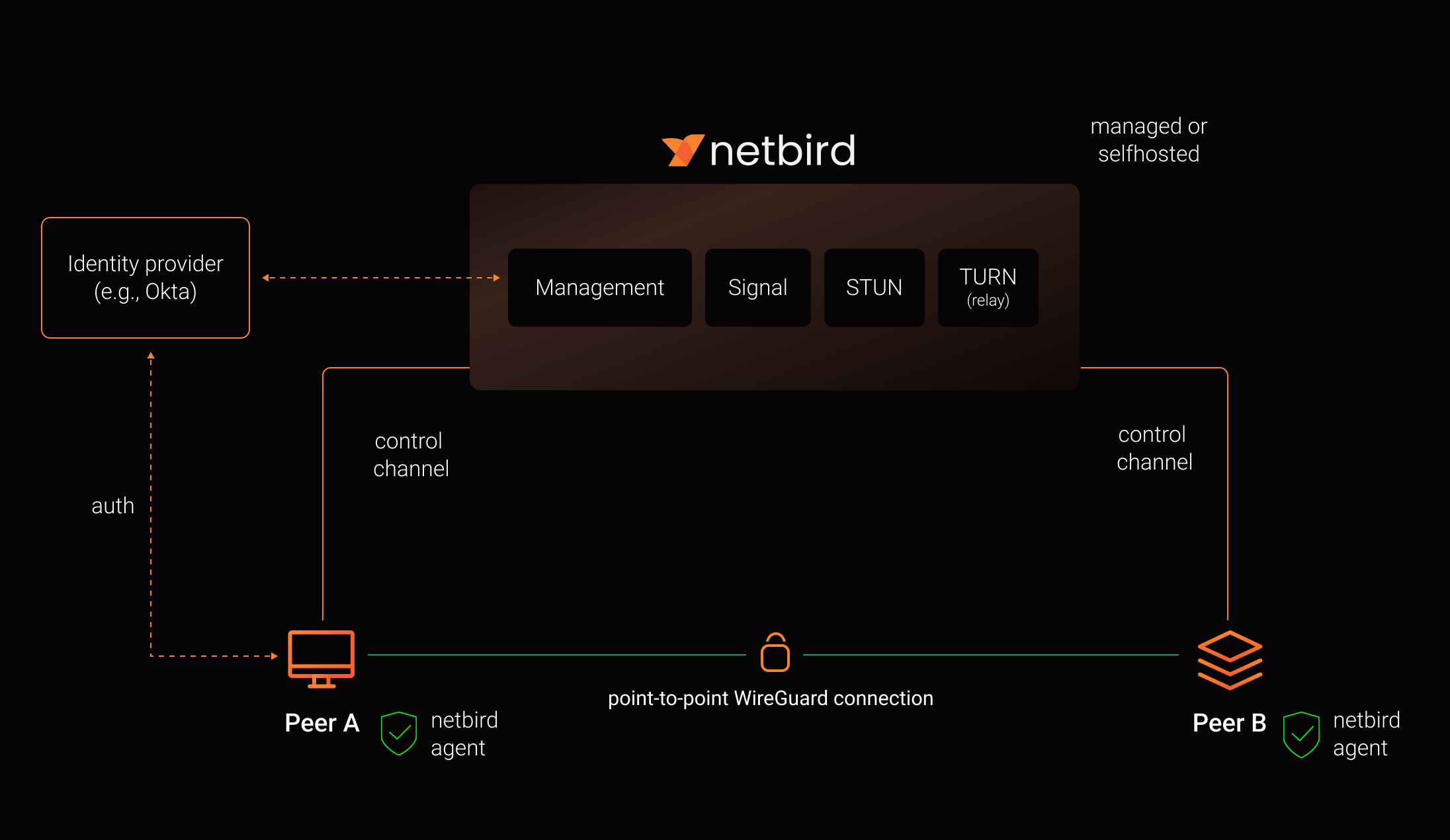
See a complete architecture overview for details.
Reporting bugs and requesting features
NetBird uses a discussion-first workflow. Bug reports and feature requests start in Discussions, not as issues.
| What you want to do | Where to go |
|---|---|
| Report a bug, regression, or unexpected behavior | Issue Triage |
| Request a feature or share an idea | Ideas & Feature Requests |
| Ask about setup, configuration, or self-hosting | Q&A / Support |
| Report a security vulnerability | Security policy, never a public thread |
Our team and maintainers triage discussions, ask follow-up questions, check for duplicates, and reproduce bugs. Validated reports are promoted to issues. This keeps the issue tracker a clear answer to one question: what is the team working on.
Please search existing discussions and issues first, including closed ones. If something similar already exists, upvote it and add your details there instead of opening a duplicate.
For bug reports, include your NetBird version, operating system, deployment type (Cloud, self-hosted, Kubernetes, or Docker), reproduction steps, expected and actual behavior, and a debug bundle where relevant:
netbird version
netbird status -d -A
netbird debug for 1m -A -S -U
-U uploads the bundle and prints a file key you can paste instead of attaching the archive.
-A anonymizes the output, which matters on a public thread. It masks most identifying details
but is not full redaction, so read the bundle before posting it. Two levels are available:
| Level | How to select | What it masks |
|---|---|---|
default |
-A / --anonymize |
Public IP addresses, IPv6 ULA addresses, MAC addresses, and domains other than netbird.io, netbird.cloud, netbird.selfhosted, and netbird.stage. IPv4 private, CGNAT, and link-local ranges are kept |
strict |
--anonymize-level strict (implies -A) |
The above, plus IPv4 private, CGNAT, and link-local ranges, peer names in front of netbird.cloud, netbird.selfhosted, and netbird.stage, and WireGuard public keys. Labels under netbird.io are kept, since it only hosts infrastructure |
See collecting a debug bundle and the CLI reference for details.
See How to use Discussions, Issues, and Pull Requests for the full workflow, or SUPPORT.md for a shorter version.
Contributing
Contributions are welcome. Read CONTRIBUTING.md first. NetBird works ticket first, anything that changes behavior needs an issue the team has agreed on before you open a pull request.
Community projects
- NetBird installer script
- netbird-tui - terminal UI for managing NetBird peers, routes, and settings
- caddy-netbird - Caddy plugin that embeds a NetBird client for proxying HTTP and TCP/UDP traffic through NetBird networks
Note: The main branch may be in an unstable or even broken state during development.
For stable versions, see releases.
Support acknowledgement
In November 2022, NetBird joined the StartUpSecure program sponsored by the Federal Ministry of Education and Research of the Federal Republic of Germany. Together with the CISPA Helmholtz Center for Information Security, NetBird brings security best practices and simplicity to private networking.

Acknowledgements
We build on open source technologies like WireGuard®, Pion ICE, and Rosenpass. We greatly appreciate the work these projects are doing, and we'd love it if you could support them too (e.g., by starring or contributing).
Legal
This repository is licensed under the BSD-3-Clause license, which applies to all parts of the repository except for the directories management/, signal/ and relay/. Those directories are licensed under the GNU Affero General Public License version 3.0 (AGPLv3). See the respective LICENSE files inside each directory.
WireGuard and the WireGuard logo are registered trademarks of Jason A. Donenfeld.