 Zoltan Pappandcoderabbitai[bot]
2d7b309004
Zoltan Pappandcoderabbitai[bot]
2d7b309004
* [client] categorize root/system-mutating tests behind a privileged build tag

Tests that need root or mutate host state (nftables/iptables/DNS, TUN/WireGuard
interfaces, routes, eBPF, SSH/service install) are now gated behind a
//go:build privileged tag. The default `go test ./client/...` runs as a non-root
user with no sudo and leaves host networking untouched; mixed files were split so
pure-logic tests stay in the default suite.

A self-hosting ory/dockertest/v4 harness (client/testutil/privileged) runs the
privileged suite inside a --privileged --cap-add=NET_ADMIN container via
`make test-privileged`; a DOCKER_CI=true guard skips the spawn when already inside
the container. Added `make test-unit` for the host-safe run.

* [client] add PRIV_RUN/PRIV_PKGS filters to the privileged test harness

The dockertest harness now reads two optional env vars when building the
in-container `go test` command: PRIV_RUN adds a -run test-name filter and
PRIV_PKGS overrides the package list. Both empty reproduce the full privileged
suite, so CI and `make test-privileged` behave as before. Lets a developer run a
single privileged test in the container, e.g.:

  PRIV_RUN=TestNftablesManager PRIV_PKGS=./client/firewall/nftables/... make test-privileged

* [client] fix unused-helper lint after the privileged test split

Splitting privileged tests into *_privileged_test.go left their shared helpers in
the untagged files, so in the default (no-tag) build they had no callers and
golangci-lint flagged them as unused.

Moved the privileged-only helpers into the privileged files next to their callers
(generateDummyHandler; createEngine/startSignal/startManagement/getConnectedPeers/
getPeers + kaep/kasp; (*mockDaemon).setJWTToken). Annotated the shared routing-test
fixtures that must stay untagged for cross-platform compilation with //nolint:unused
(systemops_bsd expected* vars, ensureIPv6DefaultRoute on bsd/windows,
loopbackIfaceWindows), matching the existing linux variant.

* [client] fix privileged test CI failures and run the harness on macOS

The host-safe unit run dropped sudo but two privileged test groups were
never tagged, and the Docker privileged job silently never ran the suite:

- Gate the ssh/server PrivilegeDropper command-construction tests behind
  the privileged tag (they require root to target a different UID); split
  them into executor_unix_privileged_test.go.
- Tag sharedsock raw-socket tests privileged (need CAP_NET_RAW).
- Fix the Docker job command: nested single quotes around the build tags
  closed the sh -c wrapper early, dropping the go list package set and the
  privileged tag, so go test ran on the empty repo root. Use double quotes.

Make the self-hosting harness usable from a dev Mac:

- Build it on darwin as well as linux; it only drives Docker.
- Resolve the active docker context endpoint into DOCKER_HOST when the
  default /var/run/docker.sock is absent (Docker Desktop, Colima, OrbStack).
- Rename the misspelled containerGoModache constant to containerGoModCache.

* Update client/internal/engine_privileged_test.go

Co-authored-by: coderabbitai[bot] <136622811+coderabbitai[bot]@users.noreply.github.com>

* Update client/internal/routemanager/systemops/systemops_linux_test.go

Co-authored-by: coderabbitai[bot] <136622811+coderabbitai[bot]@users.noreply.github.com>

* Update client/internal/routemanager/systemops/systemops_windows_test.go

Co-authored-by: coderabbitai[bot] <136622811+coderabbitai[bot]@users.noreply.github.com>

* Update client/server/server_privileged_test.go

Co-authored-by: coderabbitai[bot] <136622811+coderabbitai[bot]@users.noreply.github.com>

* [ci] Run privileged-tagged tests on darwin, windows and freebsd

The privileged build tag split moved root/system-mutating tests behind
//go:build privileged, but only the linux docker job was given the tag.
The native darwin (sudo), windows (PsExec64 -s) and freebsd VM runners
already have the required privileges, so add the privileged tag there too
to keep CI running the same set of tests as before the split.

* [ci] Exclude dockertest harness from the darwin privileged run

The privileged tag now compiles client/testutil/privileged on darwin, whose
TestRunPrivilegedSuiteInDocker spawns a container the macOS runner has no
Docker for. Exclude the harness package from the darwin list, matching the
linux job, so the privileged tests run in place without a container spawn.

---------

Co-authored-by: coderabbitai[bot] <136622811+coderabbitai[bot]@users.noreply.github.com>





Start using NetBird at netbird.io
See Documentation
Join our Slack channel or our Community forum
🚀 We are hiring! Join us at careers.netbird.io
🤖 NetBird Agent Network (Beta)
Identity-aware access control for AI agents — keyless access to LLM APIs and private resources over the encrypted NetBird tunnel. See
agent-network/or read the docs at netbird.ai.
NetBird combines a configuration-free peer-to-peer private network and a centralized access control system in a single platform, making it easy to create secure private networks for your organization or home.
Connect. NetBird creates a WireGuard-based overlay network that automatically connects your machines over an encrypted tunnel, leaving behind the hassle of opening ports, complex firewall rules, VPN gateways, and so forth.
Secure. NetBird enables secure remote access by applying granular access policies while allowing you to manage them intuitively from a single place. Works universally on any infrastructure.
https://github.com/user-attachments/assets/10cec749-bb56-4ab3-97af-4e38850108d2
Self-host NetBird (video)
Key features
Quickstart with NetBird Cloud
- Download and install NetBird at https://app.netbird.io/install.
- Follow the steps to sign up with Google, Microsoft, GitHub or your email address.
- Check the NetBird admin UI.
Quickstart with self-hosted NetBird
This is the quickest way to try self-hosted NetBird. It should take around 5 minutes to get started if you already have a public domain and a VM. Follow the Advanced guide with a custom identity provider for installations with different IdPs.
Infrastructure requirements:
- A Linux VM with at least 1 CPU and 2 GB of memory.
- The VM should be publicly accessible on TCP ports 80 and 443 and UDP port 3478.
- A public domain name pointing to the VM.
Software requirements:
- Docker with the Compose plugin (Compose v2 or higher). See the Docker installation guide.
Steps
- Download and run the installation script:
export NETBIRD_DOMAIN=netbird.example.com; curl -fsSL https://github.com/netbirdio/netbird/releases/latest/download/getting-started.sh | bash
A bit on NetBird internals
- Every machine in the network runs the NetBird agent, which manages WireGuard.
- Every agent connects to the Management Service, which holds network state, manages peer IPs, and distributes updates to agents.
- Agents use ICE (via pion/ice) to discover connection candidates for peer-to-peer connections.
- Candidates are discovered with the help of STUN servers.
- Agents negotiate a connection through the Signal Service, exchanging end-to-end encrypted messages with candidates.
- When NAT traversal fails (e.g. mobile carrier-grade NAT) and a direct p2p connection isn't possible, the system falls back to a Relay Service and a secure WireGuard tunnel is established through it.
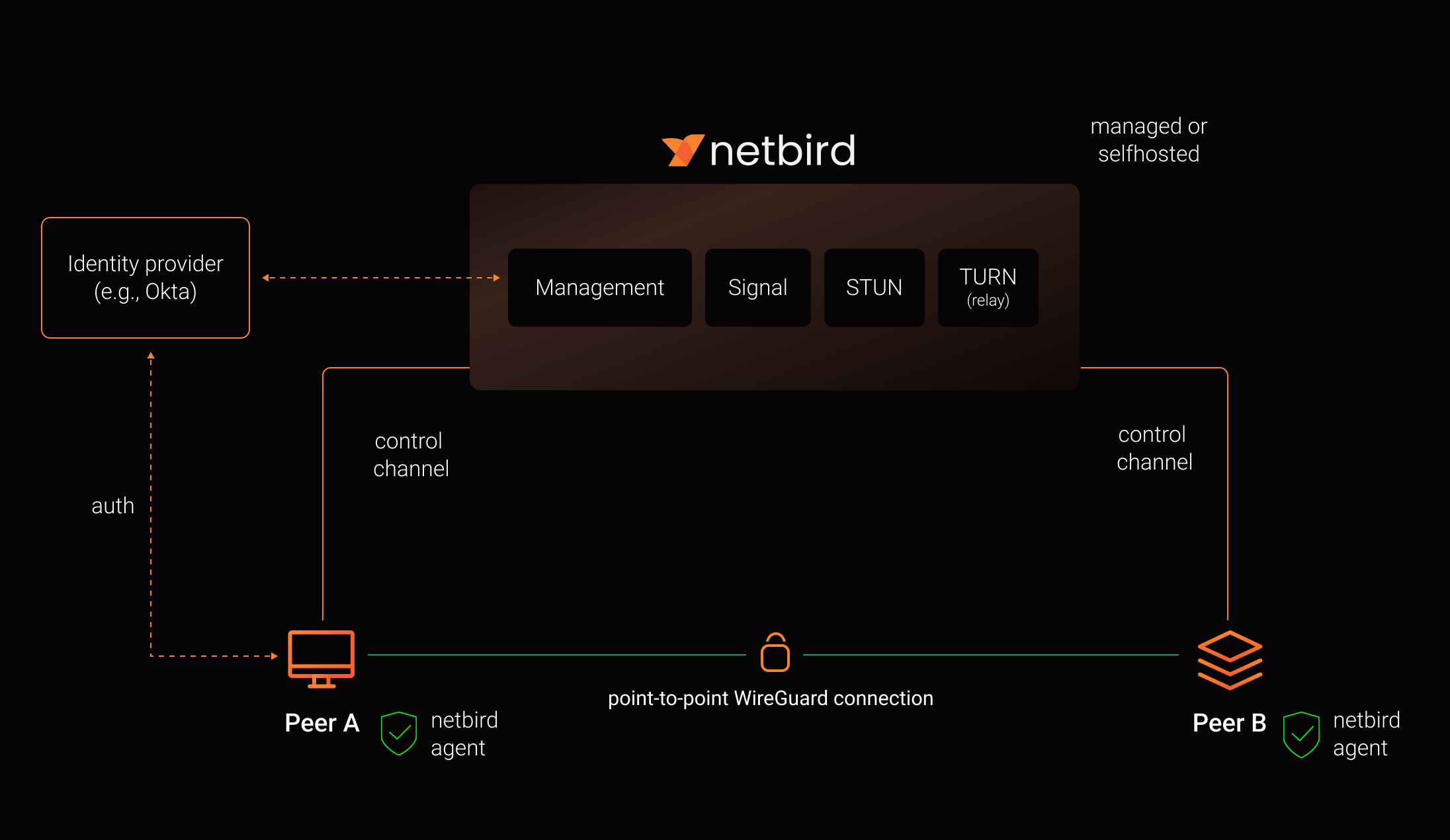
See a complete architecture overview for details.
Community projects
- NetBird installer script
- netbird-tui - terminal UI for managing NetBird peers, routes, and settings
- caddy-netbird - Caddy plugin that embeds a NetBird client for proxying HTTP and TCP/UDP traffic through NetBird networks
Note: The main branch may be in an unstable or even broken state during development.
For stable versions, see releases.
Support acknowledgement
In November 2022, NetBird joined the StartUpSecure program sponsored by the Federal Ministry of Education and Research of the Federal Republic of Germany. Together with the CISPA Helmholtz Center for Information Security, NetBird brings security best practices and simplicity to private networking.

Acknowledgements
We build on open-source technologies like WireGuard®, Pion ICE, and Rosenpass. We greatly appreciate the work these projects are doing, and we'd love it if you could support them too (e.g., by starring or contributing).
Legal
This repository is licensed under the BSD-3-Clause license, which applies to all parts of the repository except for the directories management/, signal/ and relay/. Those directories are licensed under the GNU Affero General Public License version 3.0 (AGPLv3). See the respective LICENSE files inside each directory.
WireGuard and the WireGuard logo are registered trademarks of Jason A. Donenfeld.