 Zoltan Papp
01185ba353
Zoltan Papp
01185ba353
* [client] Configure the userspace device through its typed API

The userspace configurer drove wireguard-go through UAPI text: every
write was rendered to the configuration protocol and parsed back, and
every read, including the per-second statistics poll, dumped the whole
device as text and parsed it again. With 10000 peers a statistics read
cost about 16 ms, and clearing one endpoint needed a peer remove and a
re-add because the protocol cannot clear an endpoint or drop a single
prefix in place. The allowed IP mirror in the configurer existed only
to feed those rewrites.

The wireguard-go fork now exposes a typed peer API, so the configurer
calls the device directly: ConfigurePeer for creates and updates,
single-prefix add and remove on the routing table, ClearEndpoint, and
accessors for statistics. The mirror, the UAPI rendering and the
parsers are gone from the userspace path; the UAPI socket for wg show
stays.

Clearing an endpoint keeps the peer object, its counters and its
allowed IPs, but resets the session and switches the keepalive off
until the next endpoint arrives. The watcher expects a fresh handshake
after an endpoint reset, and an endpoint-less peer with a keepalive
would retry handshakes it cannot send; this is what the remove and
re-add provided before. Handshake times now carry nanosecond precision
like the kernel path.

Measured with 10000 peers against the UAPI implementation: clearing an
endpoint drops from 713 ms to 3 ms for all peers, a statistics read
from 15 ms to 0.9 ms, a full dump from 18 ms to 4 ms, and single
allowed IP changes are 7 to 20 times faster.

* [client] Keep the allowed IP mirror kernel-only

The userspace configurer no longer uses the allowed IP mirror, so its
ensure method and the preshared key config helper had no caller left
on Windows and macOS, where the kernel configurer is not compiled, and
the unused linter failed there.

The mirror and its tests now carry the kernel build tag, the prefix
normalizers that both paths share move to common.go, and the preshared
key helper moves next to its only caller.

* [client] Trim historical references from configurer comments

* [client] Keep the endpoint zone in the userspace configurer

The UAPI path wrote the endpoint as text, so a link-local IPv6 endpoint
reached the device with its zone. The typed path built the address from
the IP bytes only and dropped the zone, leaving the device with an
unroutable fe80:: address. The activity recorder keeps the zone-less
address it always had.

* [client] Run the prefix conversion tests on every platform

prefixesToIPNets lives in the untagged common.go and the userspace stats
path uses it on every platform, but its tests stayed in the kernel-tagged
allowedips_test.go, so darwin and windows CI stopped running them. Move
them next to the normalizePrefix tests. The round-trip test stays tagged
because ipNetsToPrefixes is kernel-only.

* [client] Pin wireguard-go to the merged typed peer API

The typed peer configuration API landed on master as #23, so the
replace no longer needs to point at the PR branch commit.





Start using NetBird at netbird.io
See Documentation
Join our Slack channel or our Community forum
🚀 We are hiring! Join us at https://netbird.io/careers
🤖 NetBird Agent Network (Beta)
Identity-aware access control for AI agents — keyless access to LLM APIs and private resources over the encrypted NetBird tunnel. See
agent-network/or read the docs at netbird.ai.
NetBird combines a configuration-free peer-to-peer private network and a centralized access control system in a single platform, making it easy to create secure private networks for your organization or home.
Connect. NetBird creates a WireGuard-based overlay network that automatically connects your machines over an encrypted tunnel, leaving behind the hassle of opening ports, complex firewall rules, VPN gateways, and so forth.
Secure. NetBird enables secure remote access by applying granular access policies while allowing you to manage them intuitively from a single place. Works universally on any infrastructure.
https://github.com/user-attachments/assets/10cec749-bb56-4ab3-97af-4e38850108d2
Self-host NetBird (video)

Key features
Quickstart with NetBird Cloud
- Download and install NetBird at https://app.netbird.io/install.
- Follow the steps to sign up with Google, Microsoft, GitHub or your email address.
- Check the NetBird admin UI.
Quickstart with self-hosted NetBird
This is the quickest way to try self-hosted NetBird. It should take around 5 minutes to get started if you already have a public domain and a VM. Follow the Advanced guide with a custom identity provider for installations with different IdPs.
Infrastructure requirements:
- A Linux VM with at least 1 CPU and 2 GB of memory.
- The VM should be publicly accessible on TCP ports 80 and 443 and UDP port 3478.
- A public domain name pointing to the VM.
Software requirements:
- Docker with the Compose plugin (Compose v2 or higher). See the Docker installation guide.
Steps
- Download and run the installation script:
export NETBIRD_DOMAIN=netbird.example.com; curl -fsSL https://github.com/netbirdio/netbird/releases/latest/download/getting-started.sh | bash
A bit on NetBird internals
- Every machine in the network runs the NetBird agent, which manages WireGuard.
- Every agent connects to the Management Service, which holds network state, manages peer IPs, and distributes updates to agents.
- Agents use ICE (via pion/ice) to discover connection candidates for peer-to-peer connections.
- Candidates are discovered with the help of STUN servers.
- Agents negotiate a connection through the Signal Service, exchanging end-to-end encrypted messages with candidates.
- When NAT traversal fails (e.g. mobile carrier-grade NAT) and a direct p2p connection isn't possible, the system falls back to a Relay Service and a secure WireGuard tunnel is established through it.
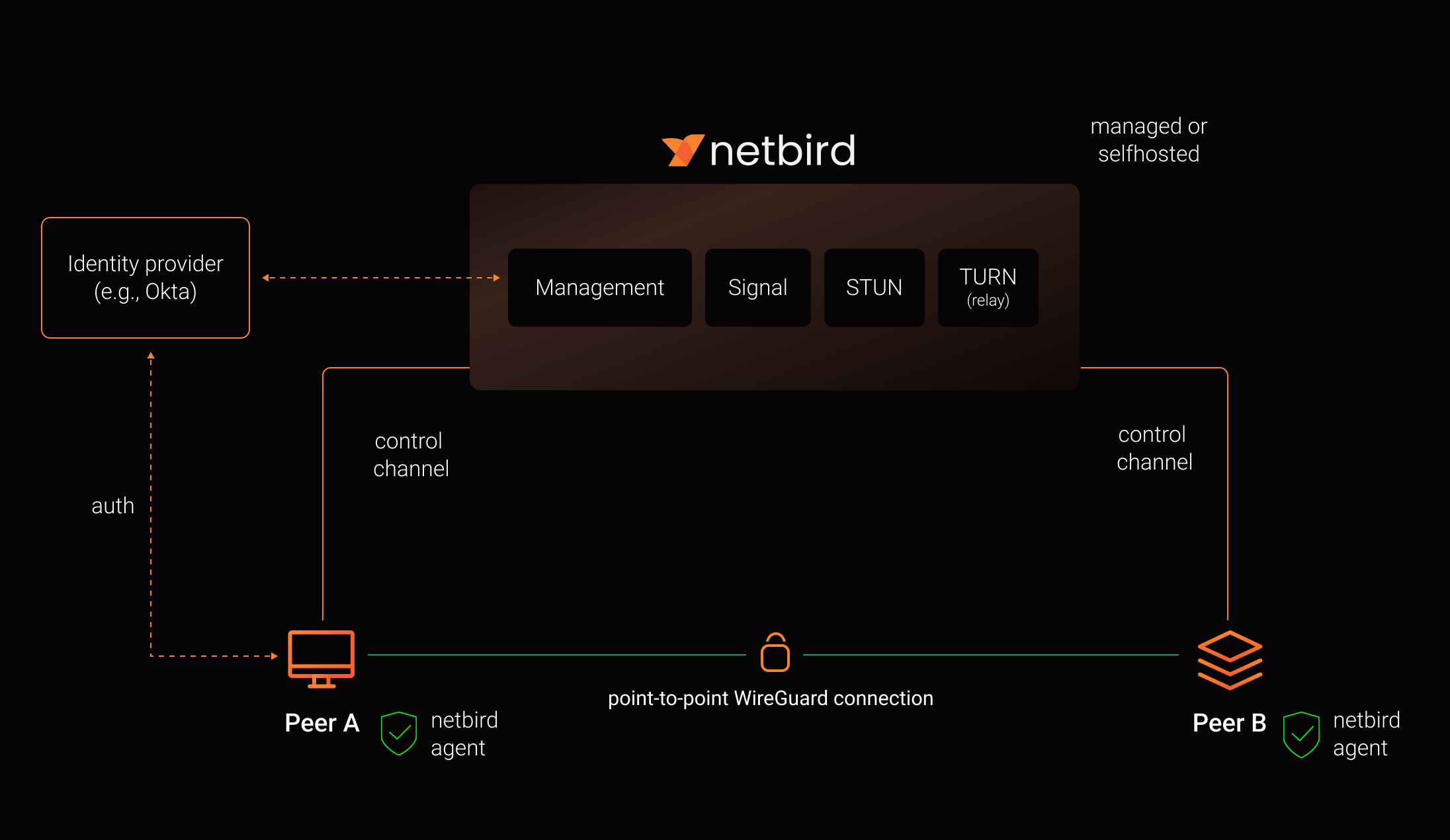
See a complete architecture overview for details.
Reporting bugs and requesting features
NetBird uses a discussion-first workflow. Bug reports and feature requests start in Discussions, not as issues.
| What you want to do | Where to go |
|---|---|
| Report a bug, regression, or unexpected behavior | Issue Triage |
| Request a feature or share an idea | Ideas & Feature Requests |
| Ask about setup, configuration, or self-hosting | Q&A / Support |
| Report a security vulnerability | Security policy, never a public thread |
Our team and maintainers triage discussions, ask follow-up questions, check for duplicates, and reproduce bugs. Validated reports are promoted to issues. This keeps the issue tracker a clear answer to one question: what is the team working on.
Please search existing discussions and issues first, including closed ones. If something similar already exists, upvote it and add your details there instead of opening a duplicate.
For bug reports, include your NetBird version, operating system, deployment type (Cloud, self-hosted, Kubernetes, or Docker), reproduction steps, expected and actual behavior, and a debug bundle where relevant:
netbird version
netbird status -d -A
netbird debug for 1m -A -S -U
-U uploads the bundle and prints a file key you can paste instead of attaching the archive.
-A anonymizes the output, which matters on a public thread. It masks most identifying details
but is not full redaction, so read the bundle before posting it. Two levels are available:
| Level | How to select | What it masks |
|---|---|---|
default |
-A / --anonymize |
Public IP addresses, IPv6 ULA addresses, MAC addresses, and domains other than netbird.io, netbird.cloud, netbird.selfhosted, and netbird.stage. IPv4 private, CGNAT, and link-local ranges are kept |
strict |
--anonymize-level strict (implies -A) |
The above, plus IPv4 private, CGNAT, and link-local ranges, peer names in front of netbird.cloud, netbird.selfhosted, and netbird.stage, and WireGuard public keys. Labels under netbird.io are kept, since it only hosts infrastructure |
See collecting a debug bundle and the CLI reference for details.
See How to use Discussions, Issues, and Pull Requests for the full workflow, or SUPPORT.md for a shorter version.
Contributing
Contributions are welcome. Read CONTRIBUTING.md first. NetBird works ticket first, anything that changes behavior needs an issue the team has agreed on before you open a pull request.
Community projects
- NetBird installer script
- netbird-tui - terminal UI for managing NetBird peers, routes, and settings
- caddy-netbird - Caddy plugin that embeds a NetBird client for proxying HTTP and TCP/UDP traffic through NetBird networks
Note: The main branch may be in an unstable or even broken state during development.
For stable versions, see releases.
Support acknowledgement
In November 2022, NetBird joined the StartUpSecure program sponsored by the Federal Ministry of Education and Research of the Federal Republic of Germany. Together with the CISPA Helmholtz Center for Information Security, NetBird brings security best practices and simplicity to private networking.

Acknowledgements
We build on open source technologies like WireGuard®, Pion ICE, and Rosenpass. We greatly appreciate the work these projects are doing, and we'd love it if you could support them too (e.g., by starring or contributing).
Legal
This repository is licensed under the BSD-3-Clause license, which applies to all parts of the repository except for the directories management/, signal/ and relay/. Those directories are licensed under the GNU Affero General Public License version 3.0 (AGPLv3). See the respective LICENSE files inside each directory.
WireGuard and the WireGuard logo are registered trademarks of Jason A. Donenfeld.