 Maycon Santos
fa1e241aea
Maycon Santos
fa1e241aea
* fix(proxy): gate tunnel-peer fast-path on inbound listener marker

forwardWithTunnelPeer previously accepted any RFC1918 / ULA / CGNAT
source IP, so a public client whose address happened to fall in those
ranges could bypass the configured operator auth scheme by colliding
with a known tunnel IP. The fast-path is now gated on
TunnelLookupFromContext(r.Context()) being present — that context value
is attached only by the per-account inbound (overlay) listener, so the
host-facing listener never enters this branch.

Tests updated to reflect the new requirement: requests that don't
carry the inbound marker now fall through to the regular auth flow.

* fix(proxy): harden inbound listener resource + startup-ctx handling

Three correctness fixes on the per-account inbound path, with tests:

- Close the logrus ErrorLog PipeWriter on tearDown. WriterLevel hands
  back an *io.PipeWriter backed by a pipe + scanner goroutine that the
  caller owns; the two writers per account (https + plain) were never
  closed, leaking the pipe and goroutine on every teardown.
- Run the post-Start hooks on context.Background(). runClientStartup
  is launched in a goroutine from AddPeer and was inheriting the
  caller's request-scoped ctx, so a cancelled request could abort the
  inbound bring-up or fail the management status notification. The
  tail is split into notifyClientReady so the contract is testable.

Tests cover the PipeWriter close behaviour and assert the readyHandler
+ NotifyStatus calls receive a non-cancelled background context.

* feat(proxy): short-circuit peer-own-target loops with 421

When a peer that hosts the target of a private service dials its own
service URL the request was being looped through the proxy and back
over WireGuard to the same peer — twice the WG round-trip for no
benefit, with no signal to the caller that something was wrong.

Add isSelfTargetLoop to ReverseProxy.ServeHTTP: when the request
arrived on the per-account overlay listener (IsOverlayOrigin) and the
source tunnel IP matches the target host, refuse the request with 421
Misdirected Request and a body pointing the operator at the backend
directly.

The gate is scoped to overlay origin so requests on the public
listener that happen to share a source IP with the target host are
forwarded normally.

* fix(management): private-service validation + tunnel-IP lookup semantics

- Require an explicit port for L4 cluster targets. validateL4Target
  exempted TargetTypeCluster from the port check, but buildPathMappings
  serializes every L4 target via net.JoinHostPort(host, port) — port=0
  shipped a ":0" upstream. Cluster targets use the same Host/Port
  fields, so the same requirement applies.
- GetPeerByIP returns NotFound on a tunnel-IP miss instead of mapping
  every error to Internal. The proxy's ValidateTunnelPeer probes IPs
  that legitimately aren't in the roster; the miss is expected and now
  distinguishable from a real store failure.
- Thread ctx into getClusterCapability's gorm query so a cancelled
  request doesn't keep the store busy.

Tests updated for the L4-cluster port requirement and the GetPeerByIP
NotFound path.

* fix(client): include offlinePeers in PeerStateByIP lookup

ReplaceOfflinePeers moves peers into d.offlinePeers but PeerStateByIP
only scanned d.peers. Callers (the local DNS filter via
localPeerConnectivity, embed.Client.IdentityForIP used by the
proxy's tunnel-peer validator) were treating known-but-offline peers
as unknown, which:

- causes the DNS filter to keep returning records pointing at peers
  that have no live tunnel, AND
- makes the proxy's local-roster check deny a request from such a
  peer rather than letting the cached management RPC carry the
  authorisation decision.

Search both slices in PeerStateByIP. Adds a unit test for the IPv4
and IPv6 offline-match paths.

* fix(rest): reject empty Delete path params in reverse-proxy clients

ReverseProxyClustersAPI.Delete and ReverseProxyTokensAPI.Delete passed
the path parameter into url.PathEscape without an empty check.
PathEscape("") returns "" which collapses the request onto the
collection endpoint ("/api/reverse-proxies/clusters/" /
"/api/reverse-proxies/proxy-tokens/"), so a caller bug delete with no
id reached a routable URL with surprising semantics (typically 405).

Short-circuit with a typed error before the request is built. Tests
mount a handler on the collection path that fails the test if hit, so
the regression is impossible to reintroduce silently.

* chore(api,ci,docs,test): private-service schema, proto-check, fixups

Non-functional cleanups and contract/CI hardening around the
private-service work:

API schema (openapi.yml):
- Require a non-empty access_groups and mode=http when private=true,
  on both Service and ServiceRequest, mirroring
  validatePrivateRequirements. mode stays optional-but-constrained
  (empty defaults to http server-side), matching runtime.

CI (proto-version-check.yml):
- Cover renamed .pb.go files (read base via previous_filename).
- Match protoc-gen-go-grpc version headers (optional "- " prefix and
  -gen-go-grpc suffix) so grpc-generated files are in scope.

Docs / comments:
- Reword Config field docs to say defaults are applied at Server.Start
  (initDefaults), not New.
- Rename the obsolete --private-inbound flag to --private across
  comments and the proto doc.

Pre-existing test fixups surfaced by review:
- Repair the integration-tagged validate_session_test.go (SignToken
  signature growth + new Manager interface methods).
- Fix the CI-skip boolean precedence so Windows isn't skipped
  unconditionally.
- Guard the router.HTTPListener type assertion with comma-ok.

* fix(proxy): background ctx for already-started AddPeer notification

The earlier ctx fix covered the async runClientStartup path but missed
the synchronous branch: when a service is added to an already-started
client, AddPeer called NotifyStatus with the caller's request-scoped
ctx. A cancelled request/stream could drop the connected notification
to management. Use context.Background() here too, matching
notifyClientReady.

Extends TestNetBird_AddPeer_ExistingStartedClient_NotifiesStatus to
pass a pre-cancelled caller ctx and assert the notification still ran
on a non-cancelled context.

* use the cmd context for roundtripper





Start using NetBird at netbird.io
See Documentation
Join our Slack channel or our Community forum
🚀 We are hiring! Join us at careers.netbird.io
NetBird combines a configuration-free peer-to-peer private network and a centralized access control system in a single platform, making it easy to create secure private networks for your organization or home.
Connect. NetBird creates a WireGuard-based overlay network that automatically connects your machines over an encrypted tunnel, leaving behind the hassle of opening ports, complex firewall rules, VPN gateways, and so forth.
Secure. NetBird enables secure remote access by applying granular access policies while allowing you to manage them intuitively from a single place. Works universally on any infrastructure.
https://github.com/user-attachments/assets/10cec749-bb56-4ab3-97af-4e38850108d2
Self-host NetBird (video)

Key features
Quickstart with NetBird Cloud
- Download and install NetBird at https://app.netbird.io/install.
- Follow the steps to sign up with Google, Microsoft, GitHub or your email address.
- Check the NetBird admin UI.
Quickstart with self-hosted NetBird
This is the quickest way to try self-hosted NetBird. It should take around 5 minutes to get started if you already have a public domain and a VM. Follow the Advanced guide with a custom identity provider for installations with different IdPs.
Infrastructure requirements:
- A Linux VM with at least 1 CPU and 2 GB of memory.
- The VM should be publicly accessible on TCP ports 80 and 443 and UDP port 3478.
- A public domain name pointing to the VM.
Software requirements:
- Docker with the Compose plugin (Compose v2 or higher). See the Docker installation guide.
Steps
- Download and run the installation script:
export NETBIRD_DOMAIN=netbird.example.com; curl -fsSL https://github.com/netbirdio/netbird/releases/latest/download/getting-started.sh | bash
A bit on NetBird internals
- Every machine in the network runs the NetBird agent, which manages WireGuard.
- Every agent connects to the Management Service, which holds network state, manages peer IPs, and distributes updates to agents.
- Agents use ICE (via pion/ice) to discover connection candidates for peer-to-peer connections.
- Candidates are discovered with the help of STUN servers.
- Agents negotiate a connection through the Signal Service, exchanging end-to-end encrypted messages with candidates.
- When NAT traversal fails (e.g. mobile carrier-grade NAT) and a direct p2p connection isn't possible, the system falls back to a Relay Service and a secure WireGuard tunnel is established through it.
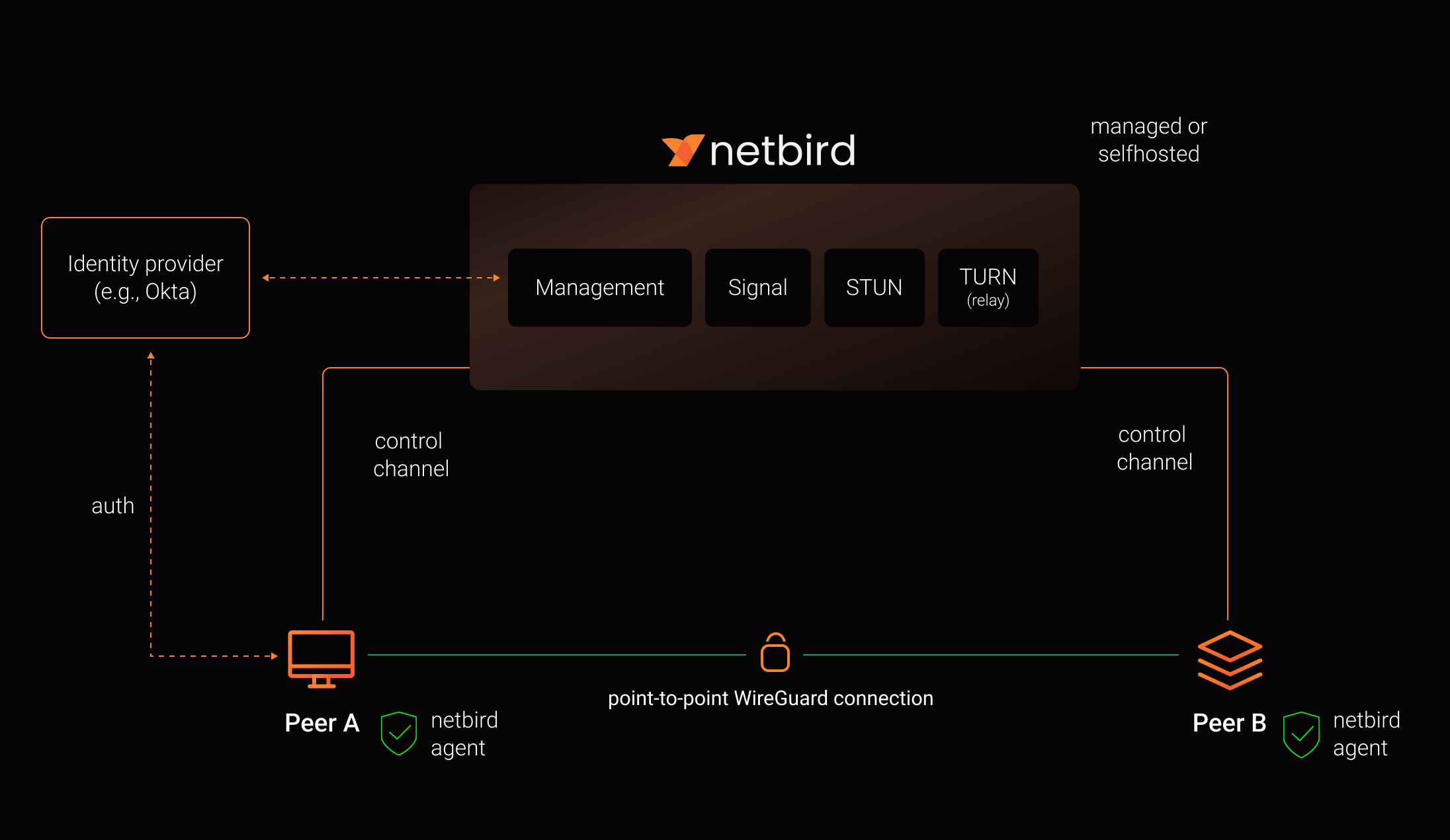
See a complete architecture overview for details.
Community projects
- NetBird installer script
- netbird-tui - terminal UI for managing NetBird peers, routes, and settings
- caddy-netbird - Caddy plugin that embeds a NetBird client for proxying HTTP and TCP/UDP traffic through NetBird networks
Note: The main branch may be in an unstable or even broken state during development.
For stable versions, see releases.
Support acknowledgement
In November 2022, NetBird joined the StartUpSecure program sponsored by the Federal Ministry of Education and Research of the Federal Republic of Germany. Together with the CISPA Helmholtz Center for Information Security, NetBird brings security best practices and simplicity to private networking.

Acknowledgements
We build on open-source technologies like WireGuard®, Pion ICE, and Rosenpass. We greatly appreciate the work these projects are doing, and we'd love it if you could support them too (e.g., by starring or contributing).
Legal
This repository is licensed under the BSD-3-Clause license, which applies to all parts of the repository except for the directories management/, signal/ and relay/. Those directories are licensed under the GNU Affero General Public License version 3.0 (AGPLv3). See the respective LICENSE files inside each directory.
WireGuard and the WireGuard logo are registered trademarks of Jason A. Donenfeld.