 Zoltan PappandViktor Liu
91f0d5cefd
Zoltan PappandViktor Liu
91f0d5cefd
* Add client metrics

* Add client metrics system with OpenTelemetry and VictoriaMetrics support

Implements a comprehensive client metrics system to track peer connection
stages and performance. The system supports multiple backend implementations
(OpenTelemetry, VictoriaMetrics, and no-op) and tracks detailed connection
stage durations from creation through WireGuard handshake.

Key changes:
- Add metrics package with pluggable backend implementations
- Implement OpenTelemetry metrics backend
- Implement VictoriaMetrics metrics backend
- Add no-op metrics implementation for disabled state
- Track connection stages: creation, semaphore, signaling, connection ready, and WireGuard handshake
- Move WireGuard watcher functionality to conn.go
- Refactor engine to integrate metrics tracking
- Add metrics export endpoint in debug server

* Add signaling metrics tracking for initial and reconnection attempts

* Reset connection stage timestamps during reconnections to exclude unnecessary metrics tracking

* Delete otel lib from client

* Update unit tests

* Invoke callback on handshake success in WireGuard watcher

* Add Netbird version tracking to client metrics

Integrate Netbird version into VictoriaMetrics backend and metrics labels. Update `ClientMetrics` constructor and metric name formatting to include version information.

* Add sync duration tracking to client metrics

Introduce `RecordSyncDuration` for measuring sync message processing time. Update all metrics implementations (VictoriaMetrics, no-op) to support the new method. Refactor `ClientMetrics` to use `AgentInfo` for static agent data.

* Remove no-op metrics implementation and simplify ClientMetrics constructor

Eliminate unused `noopMetrics` and refactor `ClientMetrics` to always use the VictoriaMetrics implementation. Update associated logic to reflect these changes.

* Add total duration tracking for connection attempts

Calculate total duration for both initial connections and reconnections, accounting for different timestamp scenarios. Update `Export` method to include Prometheus HELP comments.

* Add metrics push support to VictoriaMetrics integration

* [client] anchor connection metrics to first signal received

* Remove creation_to_semaphore connection stage metric

The semaphore queuing stage (Created → SemaphoreAcquired) is no longer
tracked. Connection metrics now start from SignalingReceived. Updated
docs and Grafana dashboard accordingly.

* [client] Add remote push config for metrics with version-based eligibility

Introduce remoteconfig.Manager that fetches a remote JSON config to control
metrics push interval and restrict pushing to a specific agent version
range. When NB_METRICS_INTERVAL is set, remote config is bypassed
entirely for local override.

* [client] Add WASM-compatible NewClientMetrics implementation

Replace NewClientMetrics in metrics.go with a WASM-specific stub in metrics_js.go, returning nil for compatibility with JS builds. Simplify method usage for WASM targets.

* Add missing file

* Update default case in DeploymentType.String to return "unknown" instead of "selfhosted"

* [client] Rework metrics to use timestamped samples instead of histograms

Replace cumulative Prometheus histograms with timestamped point-in-time
samples that are pushed once and cleared. This fixes metrics for sparse
events (connections/syncs that happen once at startup) where rate() and
increase() produced incorrect or empty results.

Changes:
- Switch from VictoriaMetrics histogram library to raw Prometheus text
  format with explicit millisecond timestamps
- Reset samples after successful push (no resending stale data)
- Rename connection_to_handshake → connection_to_wg_handshake
- Add netbird_peer_connection_count metric for ICE vs Relay tracking
- Simplify dashboard: point-based scatter plots, donut pie chart
- Add maxStalenessInterval=1m to VictoriaMetrics to prevent forward-fill
- Fix deployment_type Unknown returning "selfhosted" instead of "unknown"
- Fix inverted shouldPush condition in push.go

* [client] Add InfluxDB metrics backend alongside VictoriaMetrics

Add influxdb.go with timestamped line protocol export for sparse
one-shot events. Restore victoria.go to use proper Prometheus
histograms. Update Grafana dashboards, add InfluxDB datasource,
and update docs.

Co-Authored-By: Claude Opus 4.6 <noreply@anthropic.com>

* [client] Fix metrics issues and update dev docker setup

- Fix StopPush not clearing push state, preventing restart
- Fix race condition reading currentConnPriority without lock in recordConnectionMetrics
- Fix stale comment referencing old metrics server URL
- Update docker-compose for InfluxDB: add scoped tokens, .env config, init scripts
- Rename docker-compose.victoria.yml to docker-compose.yml

* [client] Add anonymised peer tracking to pushed metrics

Introduce peer_id and connection_pair_id tags to InfluxDB metrics.
Public keys are hashed (truncated SHA-256) for anonymisation. The
connection pair ID is deterministic regardless of which side computes
it, enabling deduplication of reconnections in the ICE vs Relay
dashboard. Also pin Grafana to v11.6.0 for file-based provisioning
and fix datasource UID references.

* Remove unused dependencies from go.mod and go.sum

* Refactor InfluxDB ingest pipeline: extract validation logic

- Move line validation logic to `validateLine` and `validateField` helper functions.
- Improve error handling with structured validation and clearer separation of concerns.
- Add stderr redirection for error messages in `create-tokens.sh`.

* Set non-root user in Dockerfile for Ingest service

* Fix Windows CI: command line too long

* Remove Victoria metrics

* Add hashed peer ID as Authorization header in metrics push

* Revert influxdb in docker compose

* Enable gzip compression and authorization validation for metrics push and ingest

* Reducate code of complexity

* Update debug documentation to include metrics.txt description

* Increase `maxBodySize` limit to 50 MB and update gzip reader wrapping logic

* Refactor deployment type detection to use URL parsing for improved accuracy

* Update readme

* Throttle remote config retries on fetch failure

* Preserve first WG handshake timestamp, ignore rekeys

* Skip adding empty metrics.txt to debug bundle in debug mode

* Update default metrics server URL to https://ingest.netbird.io

* Atomic metrics export-and-reset to prevent sample loss between Export and Reset calls

* Fix doc

* Refactor Push configuration to improve clarity and enforce minimum push interval

* Remove `minPushInterval` and update push interval validation logic

* Revert ExportAndReset, it is acceptable data loss

* Fix metrics review issues: rename env var, remove stale infra, add tests

- Rename NB_METRICS_ENABLED to NB_METRICS_PUSH_ENABLED to clarify that
  collection is always active (for debug bundles) and only push is opt-in
- Change default config URL from staging to production (ingest.netbird.io)
- Delete broken Prometheus dashboard (used non-existent metric names)
- Delete unused VictoriaMetrics datasource config
- Replace committed .env with .env.example containing placeholder values
- Wire Grafana admin credentials through env vars in docker-compose
- Make metricsStages a pointer to prevent reset-vs-write race on reconnect
- Fix typed-nil interface in debug bundle path (GetClientMetrics)
- Use deterministic field order in InfluxDB Export (sorted keys)
- Replace Authorization header with X-Peer-ID for metrics push
- Fix ingest server timeout to use time.Second instead of float
- Fix gzip double-close, stale comments, trim log levels
- Add tests for influxdb.go and MetricsStages

* Add login duration metric, ingest tag validation, and duration bounds

- Add netbird_login measurement recording login/auth duration to management
  server, with success/failure result tag
- Validate InfluxDB tags against per-measurement allowlists in ingest server
  to prevent arbitrary tag injection
- Cap all duration fields (*_seconds) at 300s instead of only total_seconds
- Add ingest server tests for tag/field validation, bounds, and auth

* Add arch tag to all metrics

* Fix Grafana dashboard: add arch to drop columns, add login panels

* Validate NB_METRICS_SERVER_URL is an absolute HTTP(S) URL

* Address review comments: fix README wording, update stale comments

* Clarify env var precedence does not bypass remote config eligibility

* Remove accidentally committed pprof files

---------

Co-authored-by: Viktor Liu <viktor@netbird.io>




Start using NetBird at netbird.io
See Documentation
Join our Slack channel or our Community forum
🚀 We are hiring! Join us at careers.netbird.io
New: NetBird terraform provider
NetBird combines a configuration-free peer-to-peer private network and a centralized access control system in a single platform, making it easy to create secure private networks for your organization or home.
Connect. NetBird creates a WireGuard-based overlay network that automatically connects your machines over an encrypted tunnel, leaving behind the hassle of opening ports, complex firewall rules, VPN gateways, and so forth.
Secure. NetBird enables secure remote access by applying granular access policies while allowing you to manage them intuitively from a single place. Works universally on any infrastructure.
Open Source Network Security in a Single Platform
https://github.com/user-attachments/assets/10cec749-bb56-4ab3-97af-4e38850108d2
Self-Host NetBird (Video)

Key features
| Connectivity | Management | Security | Automation | Platforms |
|---|---|---|---|---|
|
|
|
|
|
|
|
|
||
|
|
|
|
|
|
|
|
|
|
|
|
|
|
|
|
||||
|
||||
|
Quickstart with NetBird Cloud
- Download and install NetBird at https://app.netbird.io/install
- Follow the steps to sign-up with Google, Microsoft, GitHub or your email address.
- Check NetBird admin UI.
- Add more machines.
Quickstart with self-hosted NetBird
This is the quickest way to try self-hosted NetBird. It should take around 5 minutes to get started if you already have a public domain and a VM. Follow the Advanced guide with a custom identity provider for installations with different IDPs.
Infrastructure requirements:
- A Linux VM with at least 1CPU and 2GB of memory.
- The VM should be publicly accessible on TCP ports 80 and 443 and UDP port: 3478.
- Public domain name pointing to the VM.
Software requirements:
- Docker installed on the VM with the docker-compose plugin (Docker installation guide) or docker with docker-compose in version 2 or higher.
- jq installed. In most distributions
Usually available in the official repositories and can be installed with
sudo apt install jqorsudo yum install jq - curl installed.
Usually available in the official repositories and can be installed with
sudo apt install curlorsudo yum install curl
Steps
- Download and run the installation script:
export NETBIRD_DOMAIN=netbird.example.com; curl -fsSL https://github.com/netbirdio/netbird/releases/latest/download/getting-started.sh | bash
- Once finished, you can manage the resources via
docker-compose
A bit on NetBird internals
- Every machine in the network runs NetBird Agent (or Client) that manages WireGuard.
- Every agent connects to Management Service that holds network state, manages peer IPs, and distributes network updates to agents (peers).
- NetBird agent uses WebRTC ICE implemented in pion/ice library to discover connection candidates when establishing a peer-to-peer connection between machines.
- Connection candidates are discovered with the help of STUN servers.
- Agents negotiate a connection through Signal Service passing p2p encrypted messages with candidates.
- Sometimes the NAT traversal is unsuccessful due to strict NATs (e.g. mobile carrier-grade NAT) and a p2p connection isn't possible. When this occurs the system falls back to a relay server called TURN, and a secure WireGuard tunnel is established via the TURN server.
Coturn is the one that has been successfully used for STUN and TURN in NetBird setups.
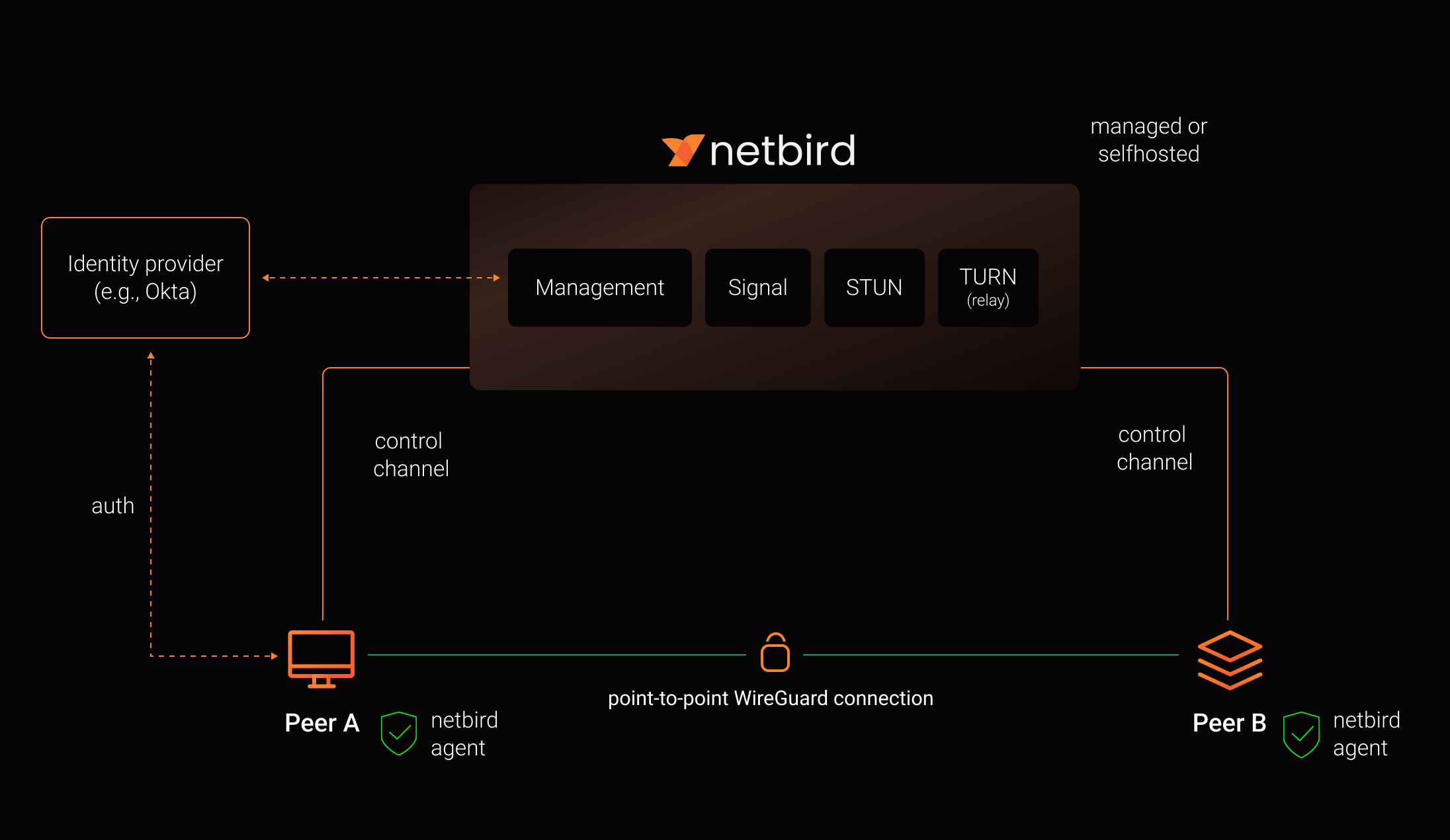
See a complete architecture overview for details.
Community projects
- NetBird installer script
- NetBird ansible collection by Dominion Solutions
- netbird-tui — terminal UI for managing NetBird peers, routes, and settings
Note: The main branch may be in an unstable or even broken state during development.
For stable versions, see releases.
Support acknowledgement
In November 2022, NetBird joined the StartUpSecure program sponsored by The Federal Ministry of Education and Research of The Federal Republic of Germany. Together with CISPA Helmholtz Center for Information Security NetBird brings the security best practices and simplicity to private networking.

Testimonials
We use open-source technologies like WireGuard®, Pion ICE (WebRTC), Coturn, and Rosenpass. We very much appreciate the work these guys are doing and we'd greatly appreciate if you could support them in any way (e.g., by giving a star or a contribution).
Legal
This repository is licensed under BSD-3-Clause license that applies to all parts of the repository except for the directories management/, signal/ and relay/. Those directories are licensed under the GNU Affero General Public License version 3.0 (AGPLv3). See the respective LICENSE files inside each directory.
WireGuard and the WireGuard logo are registered trademarks of Jason A. Donenfeld.