 Zoltan Papp
3e61ccb162
Zoltan Papp
3e61ccb162
* Persist sync response via pluggable store (disk on iOS)

The latest Management sync response (which carries the network map) was
kept in memory for debug bundle generation. On memory-constrained
platforms like iOS the network map can be large enough to matter.

Introduce a syncstore package with a Store interface and two backends:
a memory backend (the previous behavior) and a disk backend that
serializes the response to a file in the state directory. The backend
is selected per-platform at build time: disk on iOS, memory elsewhere.

The disk store clears any leftover file on construction so a fresh
store never reads stale data from an earlier run (e.g. another
profile's network map).

In the engine, drop the separate persistSyncResponse bool: the store is
only instantiated while persistence is enabled, and its presence is
what marks persistence as active. The store is also cleared on engine
close so the file does not linger on disk.

* syncstore: silence nilnil linter on "nothing stored" returns

Get returns (nil, nil) to signal that nothing is stored, which is part
of the Store contract and preserves the original behaviour. Annotate
both backends with //nolint:nilnil so golangci-lint does not flag it.

* syncstore: hold syncRespMux for the whole store Set/Get

Both handleSync and GetLatestSyncResponse snapshotted e.syncStore under
the read lock and then released it before calling Set/Get. That allowed
SetSyncResponsePersistence(false) or engine close to clear the store
mid-call. In particular a concurrent Clear()+nil followed by a late
Set could re-create the file that was just removed, defeating the
leak/lingering protection.

Hold syncRespMux for the duration of the store operation in both spots
so the store cannot be cleared while a Set/Get is in flight.

* syncstore: avoid StateDir "." when state path is empty

On mobile the state path may be empty (the engine tolerates a missing
state file). filepath.Dir("") returns ".", which would make a
disk-backed syncstore write into the working directory instead of
letting NewDiskStore fall back to os.TempDir().

Only set engineConfig.StateDir when path is non-empty.





Start using NetBird at netbird.io
See Documentation
Join our Slack channel or our Community forum
🚀 We are hiring! Join us at careers.netbird.io
NetBird combines a configuration-free peer-to-peer private network and a centralized access control system in a single platform, making it easy to create secure private networks for your organization or home.
Connect. NetBird creates a WireGuard-based overlay network that automatically connects your machines over an encrypted tunnel, leaving behind the hassle of opening ports, complex firewall rules, VPN gateways, and so forth.
Secure. NetBird enables secure remote access by applying granular access policies while allowing you to manage them intuitively from a single place. Works universally on any infrastructure.
https://github.com/user-attachments/assets/10cec749-bb56-4ab3-97af-4e38850108d2
Self-host NetBird (video)

Key features
Quickstart with NetBird Cloud
- Download and install NetBird at https://app.netbird.io/install.
- Follow the steps to sign up with Google, Microsoft, GitHub or your email address.
- Check the NetBird admin UI.
Quickstart with self-hosted NetBird
This is the quickest way to try self-hosted NetBird. It should take around 5 minutes to get started if you already have a public domain and a VM. Follow the Advanced guide with a custom identity provider for installations with different IdPs.
Infrastructure requirements:
- A Linux VM with at least 1 CPU and 2 GB of memory.
- The VM should be publicly accessible on TCP ports 80 and 443 and UDP port 3478.
- A public domain name pointing to the VM.
Software requirements:
- Docker with the Compose plugin (Compose v2 or higher). See the Docker installation guide.
Steps
- Download and run the installation script:
export NETBIRD_DOMAIN=netbird.example.com; curl -fsSL https://github.com/netbirdio/netbird/releases/latest/download/getting-started.sh | bash
A bit on NetBird internals
- Every machine in the network runs the NetBird agent, which manages WireGuard.
- Every agent connects to the Management Service, which holds network state, manages peer IPs, and distributes updates to agents.
- Agents use ICE (via pion/ice) to discover connection candidates for peer-to-peer connections.
- Candidates are discovered with the help of STUN servers.
- Agents negotiate a connection through the Signal Service, exchanging end-to-end encrypted messages with candidates.
- When NAT traversal fails (e.g. mobile carrier-grade NAT) and a direct p2p connection isn't possible, the system falls back to a Relay Service and a secure WireGuard tunnel is established through it.
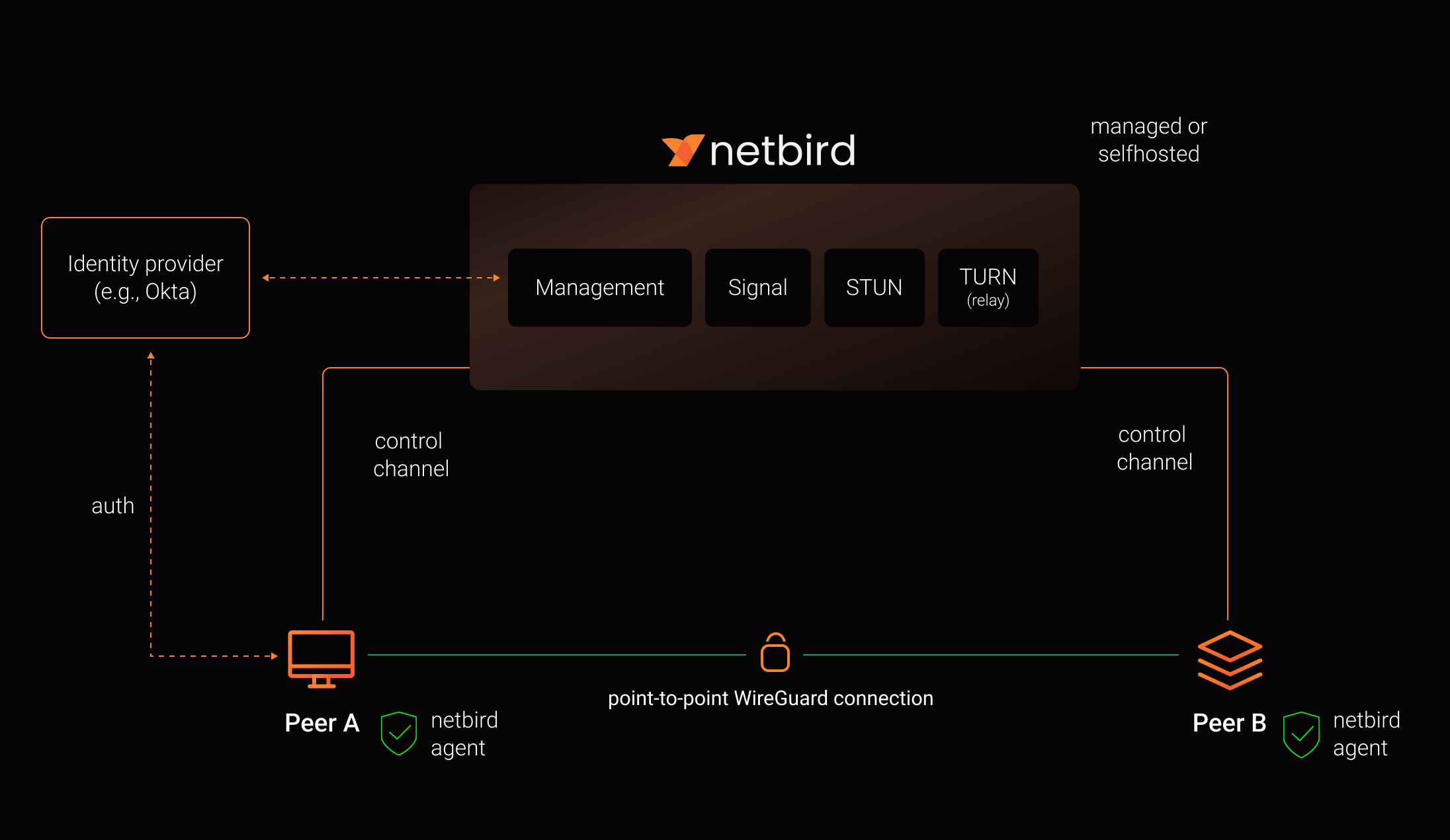
See a complete architecture overview for details.
Community projects
- NetBird installer script
- netbird-tui - terminal UI for managing NetBird peers, routes, and settings
- caddy-netbird - Caddy plugin that embeds a NetBird client for proxying HTTP and TCP/UDP traffic through NetBird networks
Note: The main branch may be in an unstable or even broken state during development.
For stable versions, see releases.
Support acknowledgement
In November 2022, NetBird joined the StartUpSecure program sponsored by the Federal Ministry of Education and Research of the Federal Republic of Germany. Together with the CISPA Helmholtz Center for Information Security, NetBird brings security best practices and simplicity to private networking.

Acknowledgements
We build on open-source technologies like WireGuard®, Pion ICE, and Rosenpass. We greatly appreciate the work these projects are doing, and we'd love it if you could support them too (e.g., by starring or contributing).
Legal
This repository is licensed under the BSD-3-Clause license, which applies to all parts of the repository except for the directories management/, signal/ and relay/. Those directories are licensed under the GNU Affero General Public License version 3.0 (AGPLv3). See the respective LICENSE files inside each directory.
WireGuard and the WireGuard logo are registered trademarks of Jason A. Donenfeld.