 Zoltán Papp
2cdc6ef1c6
Zoltán Papp
2cdc6ef1c6
The 1542-line tray.go grew into a 14-feature kitchen sink. Split it
into feature-coherent same-package siblings, give the daemon-stream
service a name that matches what it actually does, and trim the
cargo-cult context.WithCancel pattern from click handlers.

File layout (tray.go: 1542 → ~470 lines):
  - tray_status.go    onStatusEvent / applyStatus / status indicator
  - tray_icon.go      applyIcon / iconForState (tray icon painting)
  - tray_events.go    onSystemEvent + eventTitle / titleCase, plus a
                      shouldSkipSystemEvent helper that names the
                      three "daemon notification we don't surface"
                      filters
  - tray_session.go   session-expiry row + warning notification flow +
                      handleSessionExpired (moved from tray.go)
  - tray_profiles.go  loadConfig / loadProfiles / switchProfile
  - tray_exitnodes.go exit-node submenu (rebuild / refresh / toggle)

Mutex split: the kitchen-sink t.mu becomes four domain-scoped mutexes
so a long-running gRPC call in one domain can't block status-push
readers in another:
  - statusMu        connected / lastStatus / lastDaemonVersion /
                    lastNetworksRevision / pendingConnectLogin
  - sessionMu       sessionExpiresAt (read by the 30s ticker,
                    written by applySessionExpiry on every status push)
  - profileMu       activeProfile / activeUsername /
                    notificationsEnabled / switchCancel
  - exitNodesMu     row cache (read in reapplyMenuState's Repaint copy)
  - exitNodesRebuildMu  serialises ListNetworks + submenu rebuild +
                        SetMenu (already separate, kept)

Service rename: the "Peers" service handled the daemon's full
SubscribeStatus snapshot (peers, daemon version, management/signal
link state, networks revision, SSO deadline) plus the SubscribeEvents
notification stream and the profile-switch suppression filter. Peers
was a misleading name for a daemon-stream fan-out service. Rename to
DaemonFeed in services/, profileswitcher's stored reference, the
TrayServices struct, main.go wiring, and every doc comment that
referenced it. peers.go → daemon_feed.go. The Status.Peers field
itself (the peer list in the snapshot) is unchanged.

Event constant renames (wire strings unchanged so the frontend keeps
working without regenerating bindings beyond the rename):
  - EventStatus → EventStatusSnapshot
    Payload is a full Status struct (daemon-wide snapshot), not just
    a state-change ping — name the value-shape.
  - EventSystem → EventDaemonNotification
    Payload is a daemon SystemEvent meant to drive an OS toast or a
    Recent Events row. "System" was too generic; "Notification"
    matches what consumers do with it.

Concurrency fixes:
  - WaitExtendAuthSession now preempts a previous in-flight wait
    via the existing SetWaitCancel/CancelWait infrastructure on
    PendingFlow, the same pattern WaitSSOLogin uses. The previous
    waiter exits with codes.Canceled; the authsession service
    translates that to ExtendResult{Preempted: true} so the tray
    and the about-to-expire dialog stay silent on the losing flow
    instead of showing a false-failure toast. Without this, both
    a tray "Extend now" click and a dialog "Stay connected" click
    on the same deadline started two parallel IdP polls, and
    whichever lost the device-code check painted a bogus error.
  - mgmClient.ExtendAuthSession drops the dead backoff retry loop.
    The loop only retried on codes.Canceled, but the inner mgmCtx
    was derived from context.Background() and never cancelled, so
    every real error went straight to backoff.Permanent on the
    first attempt. Replace with a single
    context.WithTimeout(c.ctx, ConnectTimeout) call; daemon
    shutdown now interrupts the RPC and behaviour on real errors
    is unchanged.

Click-handler hygiene: six call sites used the cargo-cult
context.WithCancel(context.Background()) + defer cancel() pattern
without ever calling cancel() externally. Replace with
context.Background() directly (loadConfig, loadProfiles,
runExtendSession, dismissSessionWarning, handleConnect's Up,
handleDisconnect's Down). The one site that genuinely needs the
cancel — switchProfile, which stores it in t.switchCancel so
handleDisconnect can preempt the switch — keeps WithCancel.

Helper extraction: shouldSkipSystemEvent groups the three
"daemon notification we drop on the floor" checks
(new_version_available metadata, progress_window metadata, the
::/0 partner of an exit-node default-route event) behind a single
named predicate. Each had a comment explaining why; collecting
them moves the rationale into the helper docstring and shrinks
onSystemEvent to a router.





Start using NetBird at netbird.io
See Documentation
Join our Slack channel or our Community forum
🚀 We are hiring! Join us at careers.netbird.io
NetBird combines a configuration-free peer-to-peer private network and a centralized access control system in a single platform, making it easy to create secure private networks for your organization or home.
Connect. NetBird creates a WireGuard-based overlay network that automatically connects your machines over an encrypted tunnel, leaving behind the hassle of opening ports, complex firewall rules, VPN gateways, and so forth.
Secure. NetBird enables secure remote access by applying granular access policies while allowing you to manage them intuitively from a single place. Works universally on any infrastructure.
https://github.com/user-attachments/assets/10cec749-bb56-4ab3-97af-4e38850108d2
Self-host NetBird (video)
Key features
Quickstart with NetBird Cloud
- Download and install NetBird at https://app.netbird.io/install.
- Follow the steps to sign up with Google, Microsoft, GitHub or your email address.
- Check the NetBird admin UI.
Quickstart with self-hosted NetBird
This is the quickest way to try self-hosted NetBird. It should take around 5 minutes to get started if you already have a public domain and a VM. Follow the Advanced guide with a custom identity provider for installations with different IdPs.
Infrastructure requirements:
- A Linux VM with at least 1 CPU and 2 GB of memory.
- The VM should be publicly accessible on TCP ports 80 and 443 and UDP port 3478.
- A public domain name pointing to the VM.
Software requirements:
- Docker with the Compose plugin (Compose v2 or higher). See the Docker installation guide.
Steps
- Download and run the installation script:
export NETBIRD_DOMAIN=netbird.example.com; curl -fsSL https://github.com/netbirdio/netbird/releases/latest/download/getting-started.sh | bash
A bit on NetBird internals
- Every machine in the network runs the NetBird agent, which manages WireGuard.
- Every agent connects to the Management Service, which holds network state, manages peer IPs, and distributes updates to agents.
- Agents use ICE (via pion/ice) to discover connection candidates for peer-to-peer connections.
- Candidates are discovered with the help of STUN servers.
- Agents negotiate a connection through the Signal Service, exchanging end-to-end encrypted messages with candidates.
- When NAT traversal fails (e.g. mobile carrier-grade NAT) and a direct p2p connection isn't possible, the system falls back to a Relay Service and a secure WireGuard tunnel is established through it.
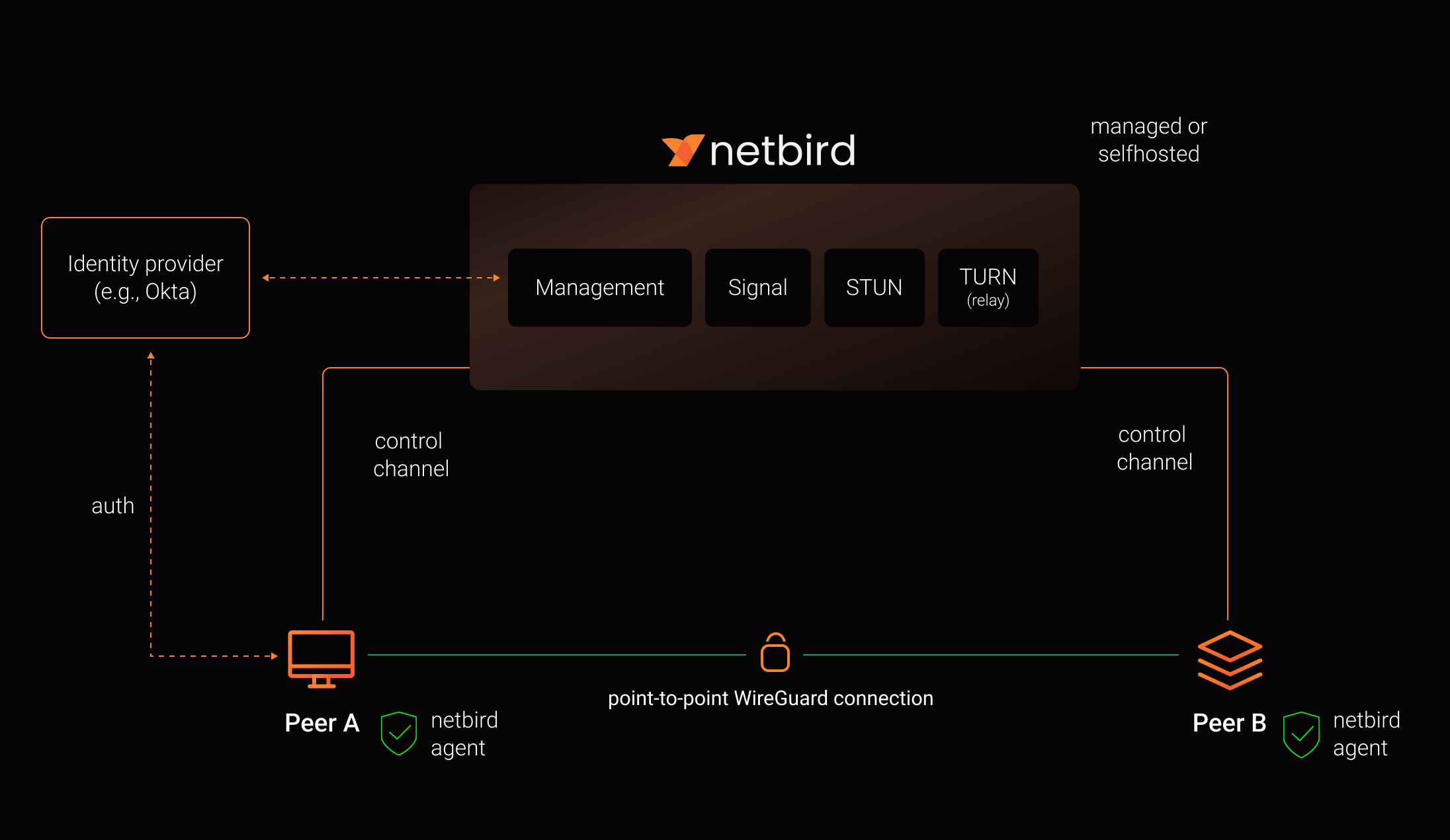
See a complete architecture overview for details.
Community projects
- NetBird installer script
- netbird-tui - terminal UI for managing NetBird peers, routes, and settings
- caddy-netbird - Caddy plugin that embeds a NetBird client for proxying HTTP and TCP/UDP traffic through NetBird networks
Note: The main branch may be in an unstable or even broken state during development.
For stable versions, see releases.
Support acknowledgement
In November 2022, NetBird joined the StartUpSecure program sponsored by the Federal Ministry of Education and Research of the Federal Republic of Germany. Together with the CISPA Helmholtz Center for Information Security, NetBird brings security best practices and simplicity to private networking.

Acknowledgements
We build on open-source technologies like WireGuard®, Pion ICE, and Rosenpass. We greatly appreciate the work these projects are doing, and we'd love it if you could support them too (e.g., by starring or contributing).
Legal
This repository is licensed under the BSD-3-Clause license, which applies to all parts of the repository except for the directories management/, signal/ and relay/. Those directories are licensed under the GNU Affero General Public License version 3.0 (AGPLv3). See the respective LICENSE files inside each directory.
WireGuard and the WireGuard logo are registered trademarks of Jason A. Donenfeld.