 2d8b0310a4
Two related fixes for the embedded netbird client and the per-account
inbound listeners that ride on its gVisor netstack.

client/internal/engine.go — replace hasIPv6Changed with reconcileIPv6:

  - First v6 assignment (current had no v6, conf carries one) is applied
    in place via WGIface.UpdateAddr instead of returning ErrResetConnection.
    Pre-fix, every embedded client whose account had IPv6 enabled would
    reset on its first NetworkMap sync — boot config has no v6, the sync
    introduces one, the engine tore itself down to "apply" it. That
    teardown destroys the gVisor netstack and orphans every listener
    bound on it, which is what made the proxy's per-account :80/:443
    silently stop accepting traffic.
  - v6 removed clears in place.
  - v6 swapped to a different non-empty value still resets (gVisor
    netstack can't safely swap its address at runtime).
  - Mutates e.config.WgAddr to match the applied state so subsequent
    PeerConfig comparisons are stable.

proxy/internal/tcp/accept.go (new) + proxy/inbound.go +
proxy/internal/tcp/router.go — harden the two Accept() loops on
netstack-backed listeners:

  - IsClosedListenerErr recognises net.ErrClosed AND gVisor's
    "endpoint is in invalid state" — the latter survives gonet's
    *net.OpError wrapping in a way errors.Is(.., net.ErrClosed) does
    not. Without this the loop spins CPU-hot after the underlying
    netstack is destroyed (peer rekey, embedded-client reset, account
    churn), emitting one log line per iteration.
  - AcceptBackoff implements the exponential backoff that
    net/http.Server.Serve uses on transient Accept errors: 5ms doubling
    up to 1s. Defence-in-depth so an unknown sticky error cannot burn
    a CPU core even if IsClosedListenerErr misses its signature.

proxy/internal/roundtrip/netbird.go — emit a single structured INFO
line summarising every embed.Options flag (account_id, service_id,
public_key, management_url, wg_port, block_inbound, block_lan_access,
disable_ipv6, no_userspace, presence of credentials) when each
per-account embedded client is created. Secrets reduced to a "present"
boolean — never logged verbatim. Diagnostic-only; no behavior change,
but it makes the "why is this embedded peer misbehaving" loop a single
log read instead of a code dive.

Tests (real listeners, scripted errors, no mocks of production code):
  - engine_reconcileipv6_test.go: 8 cases for every transition (first
    assignment, no change, removed, prefix-length changed, value
    changed, invalid bytes, UpdateAddr error) plus a updateConfig
    integration check that the fix actually fires on a v6-added
    PeerConfig.
  - accept_test.go: IsClosedListenerErr matrix + AcceptBackoff
    progression / cap / reset / cancel-during-wait / cancel-before-call.
  - router_test.go, inbound_test.go: scriptedAcceptListener +
    TestRouter_Serve_ExitsOnGVisorInvalidEndpoint and
    TestFeedRouterFromListener_ExitsOnGVisorInvalidEndpoint —
    regression guards that fail in 2 s if the loop ever spins.





Start using NetBird at netbird.io
See Documentation
Join our Slack channel or our Community forum
🚀 We are hiring! Join us at careers.netbird.io
NetBird combines a configuration-free peer-to-peer private network and a centralized access control system in a single platform, making it easy to create secure private networks for your organization or home.
Connect. NetBird creates a WireGuard-based overlay network that automatically connects your machines over an encrypted tunnel, leaving behind the hassle of opening ports, complex firewall rules, VPN gateways, and so forth.
Secure. NetBird enables secure remote access by applying granular access policies while allowing you to manage them intuitively from a single place. Works universally on any infrastructure.
https://github.com/user-attachments/assets/10cec749-bb56-4ab3-97af-4e38850108d2
Self-host NetBird (video)

Key features
Quickstart with NetBird Cloud
- Download and install NetBird at https://app.netbird.io/install.
- Follow the steps to sign up with Google, Microsoft, GitHub or your email address.
- Check the NetBird admin UI.
Quickstart with self-hosted NetBird
This is the quickest way to try self-hosted NetBird. It should take around 5 minutes to get started if you already have a public domain and a VM. Follow the Advanced guide with a custom identity provider for installations with different IdPs.
Infrastructure requirements:
- A Linux VM with at least 1 CPU and 2 GB of memory.
- The VM should be publicly accessible on TCP ports 80 and 443 and UDP port 3478.
- A public domain name pointing to the VM.
Software requirements:
- Docker with the Compose plugin (Compose v2 or higher). See the Docker installation guide.
Steps
- Download and run the installation script:
export NETBIRD_DOMAIN=netbird.example.com; curl -fsSL https://github.com/netbirdio/netbird/releases/latest/download/getting-started.sh | bash
A bit on NetBird internals
- Every machine in the network runs the NetBird agent, which manages WireGuard.
- Every agent connects to the Management Service, which holds network state, manages peer IPs, and distributes updates to agents.
- Agents use ICE (via pion/ice) to discover connection candidates for peer-to-peer connections.
- Candidates are discovered with the help of STUN servers.
- Agents negotiate a connection through the Signal Service, exchanging end-to-end encrypted messages with candidates.
- When NAT traversal fails (e.g. mobile carrier-grade NAT) and a direct p2p connection isn't possible, the system falls back to a Relay Service and a secure WireGuard tunnel is established through it.
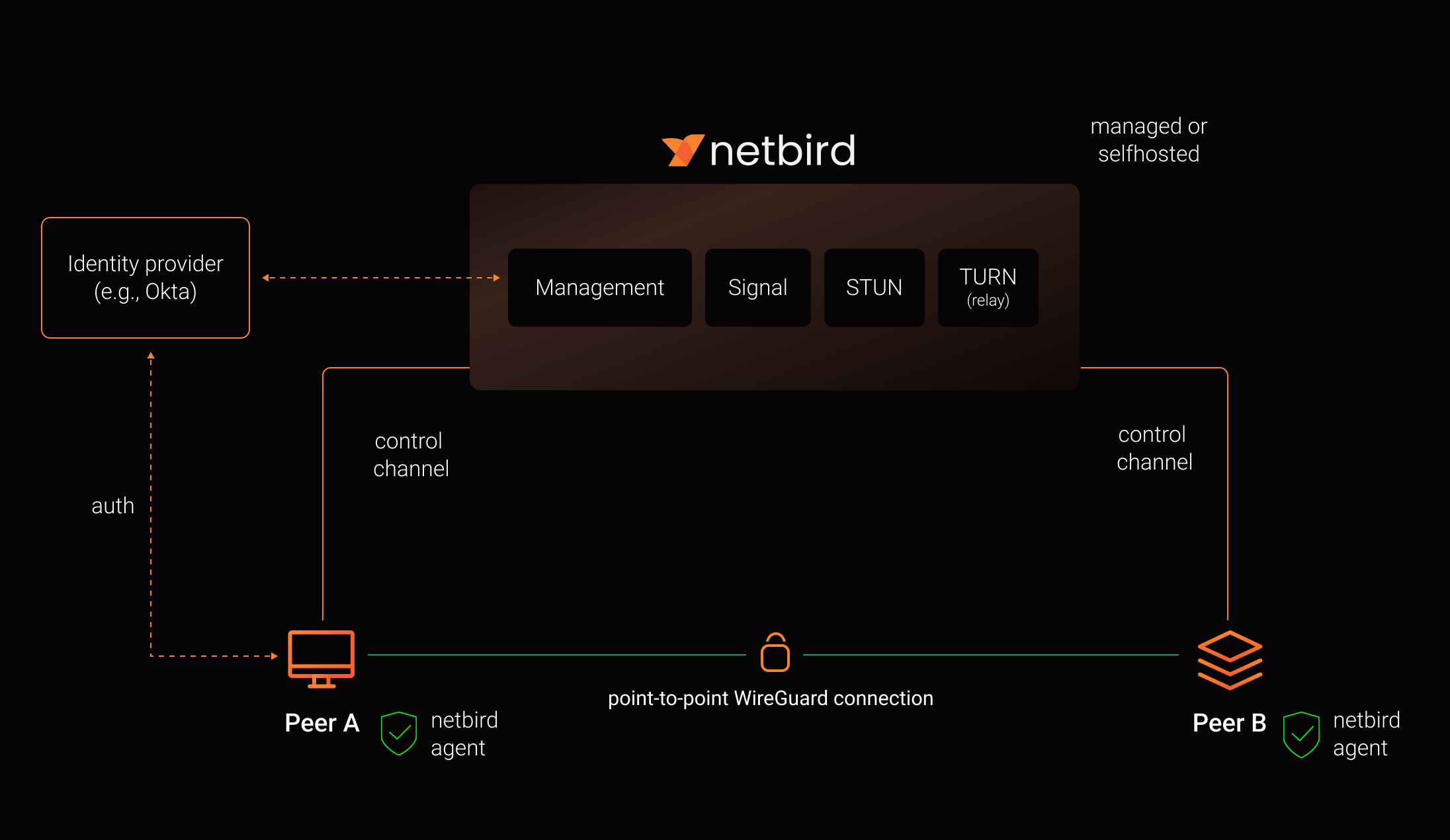
See a complete architecture overview for details.
Community projects
- NetBird installer script
- netbird-tui - terminal UI for managing NetBird peers, routes, and settings
- caddy-netbird - Caddy plugin that embeds a NetBird client for proxying HTTP and TCP/UDP traffic through NetBird networks
Note: The main branch may be in an unstable or even broken state during development.
For stable versions, see releases.
Support acknowledgement
In November 2022, NetBird joined the StartUpSecure program sponsored by the Federal Ministry of Education and Research of the Federal Republic of Germany. Together with the CISPA Helmholtz Center for Information Security, NetBird brings security best practices and simplicity to private networking.

Acknowledgements
We build on open-source technologies like WireGuard®, Pion ICE, and Rosenpass. We greatly appreciate the work these projects are doing, and we'd love it if you could support them too (e.g., by starring or contributing).
Legal
This repository is licensed under the BSD-3-Clause license, which applies to all parts of the repository except for the directories management/, signal/ and relay/. Those directories are licensed under the GNU Affero General Public License version 3.0 (AGPLv3). See the respective LICENSE files inside each directory.
WireGuard and the WireGuard logo are registered trademarks of Jason A. Donenfeld.